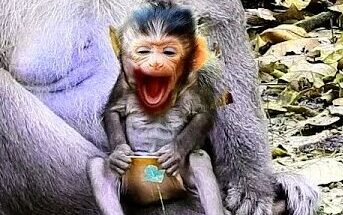
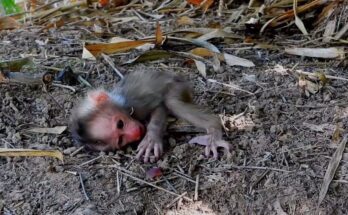
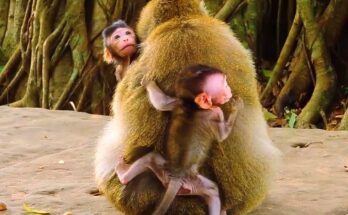
I still remember that morning. A silence so deep it felt like the world had paused — only broken by distant calls of birds and the soft rustle of leaves. I had risen before sunrise, slipping away from the temple grounds of Angkor Wat, heading deeper into the forest where few tourists ever venture. I carried little: just a camera, a worn notebook, and a hope to see life beyond temple stones — raw, untamed, real.
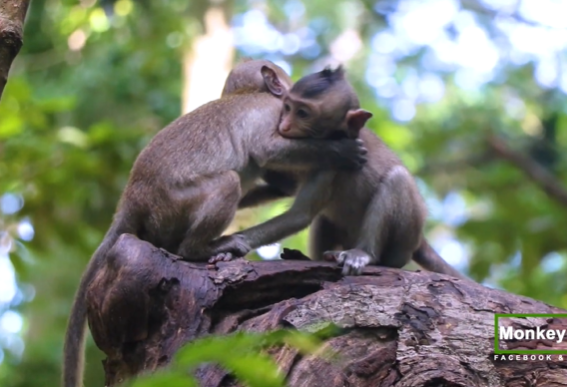
The forest was cool and damp, the air heavy with ancient wood and rich earth. Silver mist curled between the trunks, hugging mossy stones that time nearly forgot. The rising sun painted golden streaks across the canopy, light weaving through vines and dangling leaves. That’s when I saw her — a mother macaque, chestnut-furred and gentle-eyed — perched on a fallen log, holding something small and fragile close to her chest.
As the light finally warmed the jungle floor, the mother revealed what she guarded so tenderly: a baby, no more than a few days old. Its eyes fluttered open, uncertain, as though waking for the very first time. I held my breath. In that stillness, the forest seemed to lean in.
The baby’s first yawn was soft, a little squeak echoing through the dawn air. The mother nuzzled him, her fingers brushing through delicate fur, cradling him as if she’d been waiting centuries for his arrival. Around us, the forest hushed — not out of fear, but in reverence.
I watched as the little one tried to lift his head, struggled, then tilted it again, gazing at golden beams of sunlight. His eyes wide, curious. His tiny chest rising and falling. And for a moment, I wasn’t a tourist, a traveler, or a photographer. I was simply a witness — to birth, hope, survival.
Over the next hour, the mother groomed him, softly chattering to reassure him. A few other macaques drifted nearby, silent observers. A wind stirred — carrying with it the scent of damp leaves and wild fruit. Somewhere deep in the forest, a gibbon called, its lonely song traveling far into the morning hush.
I wondered: what stories would this baby tell someday? Would he climb high above these ancient trees, leap between branches, scamper through ruined corridors of lost temples? Would he survive the pressures creeping into his world — a world of tourists, plastic bottles, easy bananas tossed by cameras, temptation, danger?
Because I knew that for many in the forest around Angkor Wat, life had already changed. The lush trees and tangled vines still stood, but the presence of humans — and their obsession with photos and fleeting moments — had altered how monkeys lived. Once wild, now curious. Once free, now dependent. The very soul of the forest was shifting. Phnom Penh Post+2EAC News+2
But in that moment, cradled beneath ancient leaves and golden light, this mother and her baby embodied something timeless: love, protection, and the sacred beginning of life in the wild.
I stayed for two hours, heart pounding, watching the baby cling tight, its mother alert and watchful. When I finally left — careful to make no sudden sound — I felt like I was leaving something precious behind. Not a photograph, not a souvenir, but a living poem.
Back at the temple gates, I saw tourists with bananas, cameras ready, laughing and eager for a cute snapshot. I walked away with something far more valuable: a memory that will forever shape how I see monkeys, forests, and what it truly means to belong.
If you visit Angkor — or anywhere like it — I hope you treat the forest with that same reverence. Don’t toss a banana. Don’t chase the perfect shot. Sit quietly. Watch. Listen. Because sometimes — if you’re lucky — the forest whispers its oldest secrets.