Long before the first tourist buses arrived at the gates of Angkor Wat, the macaques were already there. They moved through the stone corridors of temples built in the ninth century, claimed the roots of strangler figs as sleeping perches, and raised their young in the shadow of one of humanity’s greatest architectural achievements. They are still there today — and increasingly, they are being watched.
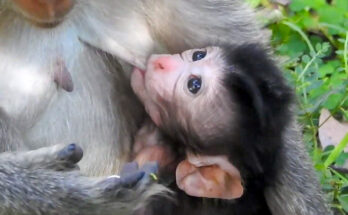
A recent video from the YouTube channel Angkor Monkey Stories offers a small but vivid window into that world. It shows a newborn monkey gently seeking comfort and milk while his mother rests nearby — a scene so intimate and unhurried that it feels almost removed from the famous landscape surrounding it. Yet it is entirely of that place.
The monkeys documented by Angkor Monkey Stories are long-tailed macaques, a species widely distributed across Southeast Asia and well adapted to life alongside human populations. In the Angkor Archaeological Park in Siem Reap Province, Cambodia, they have become part of the living fabric of a UNESCO World Heritage Site. Tourists photograph them. Monks tolerate them. Vendors occasionally feed them. And researchers study them as a population shaped by centuries of proximity to human activity.
That history matters when watching a video like this one. The mother resting in the footage is not simply an anonymous wild animal. She is part of a social group with its own hierarchy, its own territorial patterns, its own memory of this landscape. Her newborn, pressing softly toward her in those first hours of life, has been born into one of the most observed monkey populations in the world — and one of the most historically layered.
Angkor Monkey Stories approaches this subject with the patience the material demands. Rather than staging confrontations or feeding behavior, the channel documents the rhythms of daily life: grooming sessions, troop movements, juveniles at play, and moments like this one — quiet, unforced, and rich with biological meaning.
For primatologists and wildlife observers, early infancy in macaque troops is a period of particular significance. The bond formed between mother and newborn in these first days establishes patterns of attachment that influence behavior throughout the animal’s life. The tenderness visible in this video is not incidental. It is foundational.
For Cambodia, the macaques of Angkor represent something layered and sometimes complicated — a wild population thriving inside a protected cultural site, drawing both affection and occasional concern from conservationists monitoring their numbers and health. Their story is bound up with human history in ways that few wildlife populations anywhere in the world can claim.
In that context, a newborn monkey seeking his mother’s warmth becomes more than a charming scene. It is one more life beginning in a place that has witnessed ten centuries of them.
Source: Angkor Monkey Stories, YouTube.
Watch the original video →