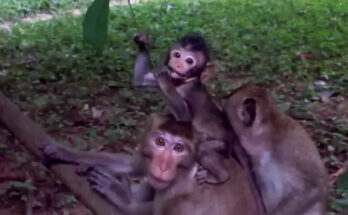
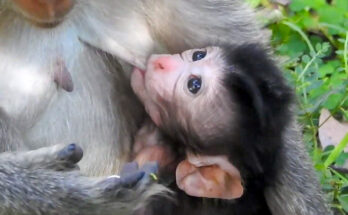
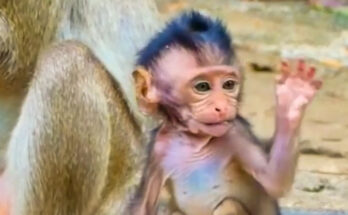
It began with a tumble. One moment the small macaque was scrambling to keep up, and the next he was rolling across the ground in a blur of brown fur and flailing limbs — not from injury, but from something far more primal: the overwhelming distress of being left behind.
Footage captured by the Asian Macaques YouTube channel documents a striking moment in the life of a young monkey whose mother moved on without him. What followed was less a tantrum and more an unfiltered expression of helplessness — the infant spinning, tumbling, and writhing in what observers might recognise as the unmistakable language of abandonment.
A Fall That Said Everything
The moment the baby monkey hit the ground, something shifted. Rather than picking himself up and giving chase, he gave in to the frustration entirely. His tiny body twisted and rolled, almost like a spinning top, each rotation a punctuation mark in a silent argument he was having with the world. It was equal parts heartbreaking and startlingly human.
Primatologists and wildlife observers have long documented that infant macaques are extraordinarily dependent on their mothers in the early months of life. Physical contact — riding on the mother’s belly, clinging to her back — is not merely comfort. It is survival. When that contact breaks, even briefly, the emotional response in young primates can be intense and immediate.
More Than Just Drama
To a casual viewer, the baby’s spinning collapse might look like theatre. But ethologists — scientists who study animal behaviour — would recognise it as something more layered. Young macaques who experience separation distress often display physical protest behaviours: vocalising, throwing themselves to the ground, or moving in erratic patterns. These are not performances. They are genuine distress signals, biologically wired to compel a maternal response.
In this case, as documented in the video, the mother had moved away from her infant — whether distracted, pressured by the group, or simply moving faster than the youngster could manage. The result was a small creature confronting a very large emotional reality: he had been left, and he did not know what to do with that.
The spinning motion that gave the video its memorable quality is, in itself, a telling detail. Physical agitation — rocking, rolling, spinning — is a documented self-stimulatory behaviour in stressed primates. It is the body trying to manage what the mind cannot yet process.
A Moment Caught on Camera
The Asian Macaques channel has built a dedicated following by filming the social lives of macaque troops across Asia, capturing moments of tenderness, conflict, hierarchy, and play. Videos like this one resonate precisely because they sit at the intersection of the familiar and the wild — behaviour that any parent or child might recognise, expressed by a creature living an entirely different kind of life.
There is something quietly profound about watching an infant animal respond to emotional pain in ways that mirror our own. The baby monkey did not have words. He had only his body, and he used it with complete, unguarded honesty.
By the time the moment passed, the infant had found his footing again — as young animals, and young humans alike, tend to do. But the few seconds of that spinning, tumbling protest lingered: a small drama played out on the forest floor, carrying far more weight than its size might suggest.
Source: Asian Macaques YouTube channel. Watch the original footage at the Asian Macaques channel on YouTube.
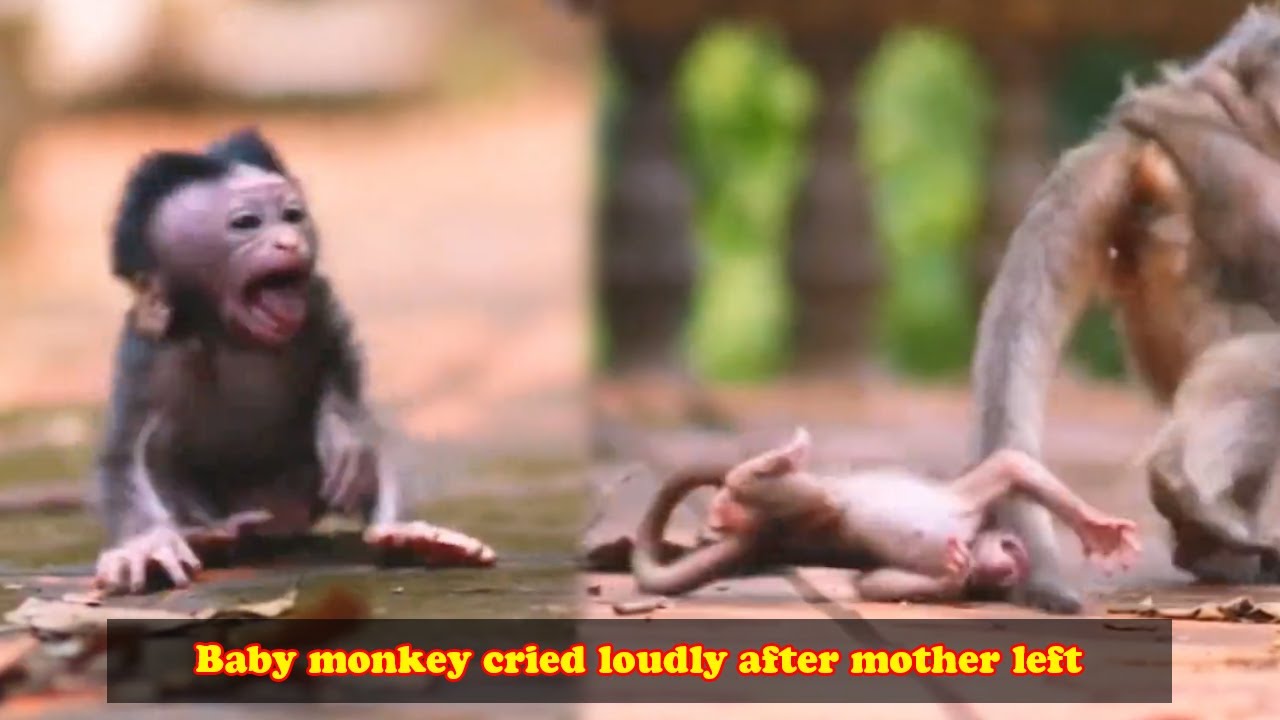
Watch the original video →