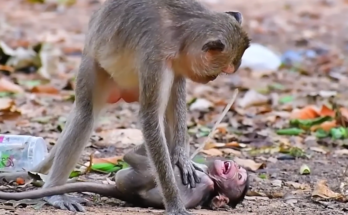
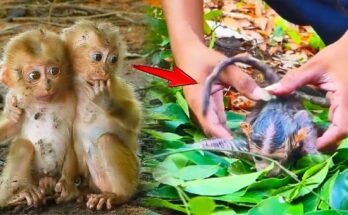
Somewhere in a tree-lined habitat familiar to wildlife observers, a small baby macaque named Leo is having a very bad day. His mother grips him, repositions him, moves in ways that leave the tiny monkey wailing. His cries are loud, sustained, and unmistakable in their distress. The scene, captured by the YouTube channel Monkey Library, is not unusual in the world of primate behavioral observation — but for those encountering it for the first time, it can be startling.
Understanding Macaque Maternal Behavior
Macaques are among the most studied primates on earth. Decades of field research have revealed that maternal behavior within macaque populations is far from uniform. Some mothers are what primatologists describe as protective and nurturing — they hold their infants close, groom them frequently, and respond quickly to their cries. Others fall on the opposite end of the spectrum, displaying what researchers have categorized as rejecting or restrictive parenting styles.
A rejecting mother may push her infant away, handle it roughly, or fail to respond to distress signals in ways that seem intuitive to human observers. A restrictive mother may hold her infant tightly but in ways that limit the baby’s movement and cause visible discomfort. Both styles have been extensively documented in wild and semi-wild macaque populations, and both exist within the natural range of primate behavior.
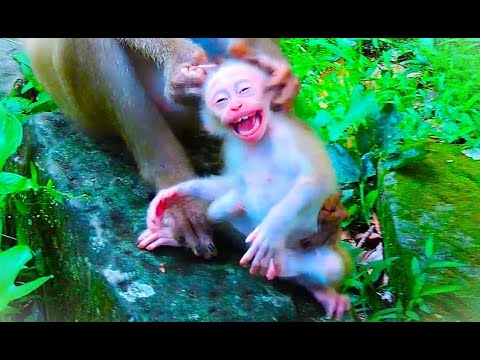
Baby Leo’s experience, as shown in the Monkey Library footage, appears to fall somewhere in this complex behavioral landscape. His mother’s handling provokes loud and sustained crying, and his facial expressions — captured in close detail by the camera — convey genuine distress. Yet the behavior, however difficult to watch, is not necessarily outside the bounds of what primatologists have observed and recorded for decades.
The Role of Observation Channels
Channels like Monkey Library have become an important, if sometimes controversial, part of the wildlife observation ecosystem. Operating in areas where macaque populations are accessible to cameras, these channels document daily life among the monkeys — feeding, grooming, social interactions, conflicts, births, and yes, moments of maternal behavior that range from tender to troubling.
The value of such documentation lies in its consistency and accessibility. While formal primatological research is published in academic journals read by specialists, channels like Monkey Library bring primate behavior to a global audience. A viewer in any country can watch baby Leo’s interaction with his mother and, with some context, begin to understand the complexity of macaque social and family life.
What the Science Tells Us
Research published over the past several decades has established that macaque mothering styles can be influenced by numerous factors. A mother’s own upbringing plays a significant role — females who were raised by harsh mothers are more likely to display similar behavior with their own offspring. Social rank within the troop matters as well; lower-ranking females often experience higher stress levels, which can affect their parenting. Environmental factors, including food availability and the presence of threats, also shape maternal behavior.
None of this is to excuse or dismiss baby Leo’s distress. His cries are real, and his discomfort is visible. But understanding the context in which this behavior occurs allows observers to move beyond a purely emotional reaction and engage with the broader science of primate development and social behavior.
Leo’s Place in a Larger Story
Baby Leo is one infant in what is likely a large and socially complex troop. His experience with his mother, as captured in this single video, represents a snapshot — a few minutes from a life that will unfold over years. Whether his mother’s behavior will soften as he grows, whether he will develop the resilience common to young macaques raised in challenging conditions, and whether his relationship with his mother will shift over time are all questions that only continued observation can answer.
For now, what the footage provides is a window into the reality of primate life — a reality that is complex, sometimes harsh, and always more nuanced than a single video can fully convey.
Source: “S-ad Facial Of Baby LEO Was C-rying L0udly For Mom St0p !!Mom’s Behavior Is Making Baby LEO H-ardly” — Monkey Library, YouTube (https://www.youtube.com/watch?v=o7hl7aOefKs)
Watch the original video →