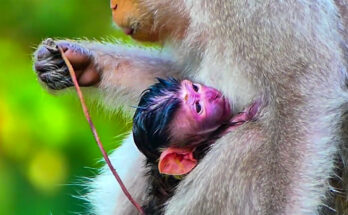
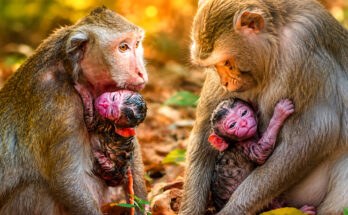
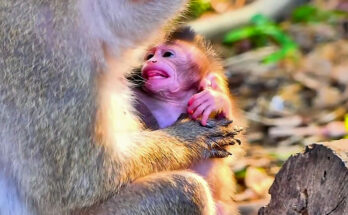
The morning I filmed this, the forest at Angkor Wat was doing what it always does just after sunrise — breathing slowly, filling with light in long gold strips between the trees. Most of the troop had already moved deeper into the canopy, but one mother had stayed back near the old stone wall with her newborn pressed flat against her chest.
She was young — I could tell by the way she moved, a little uncertain, carrying her baby with the careful tension of someone still learning. The infant was maybe two or three weeks old, still pink-faced and wide-eyed, gripping her fur the way only the very young hold on — like the whole world depends on it.
She jumped.
It wasn’t a long leap, maybe four feet between two crumbling blocks of sandstone, but she misjudged the landing. Her back feet slipped on the moss-covered edge and for one terrible second her whole body lurched sideways. The baby swung out — one tiny hand lost its grip — and I held my breath.
She caught herself. One arm hooked the stone, her body twisted, and she pulled the infant back in tight against her in a single fluid motion. She sat very still for a moment after that. Not frozen with fear exactly, but pausing — the way any new mother might after a close call, just breathing, just checking.
The baby nuzzled into her neck like nothing had happened.
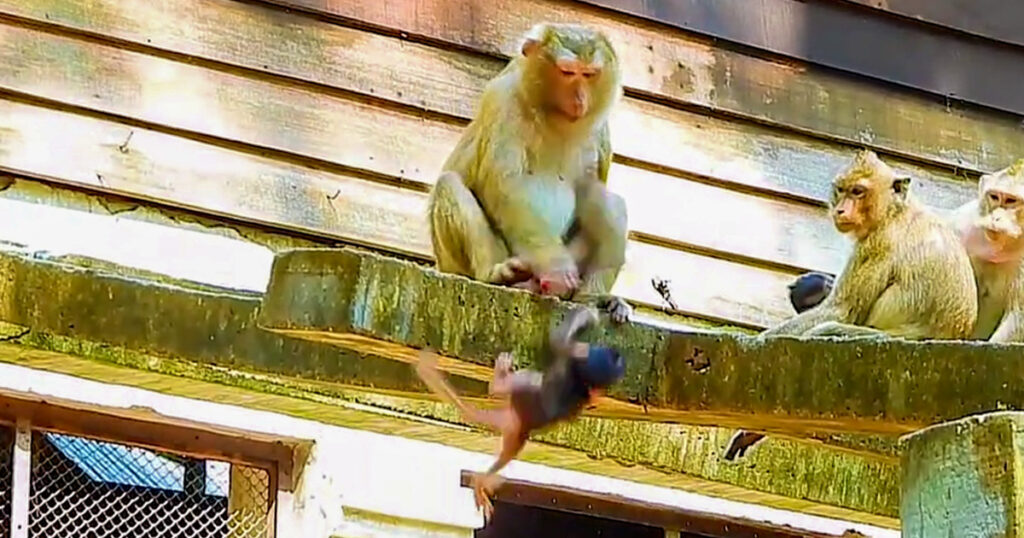
I’ve spent a lot of mornings in this forest and I’ve seen mothers carry infants through all kinds of terrain — up vertical stone faces, through tangled vines, across gaps that would make most people nervous just watching. They almost never drop them. But almost never is not never, and this was the closest I’ve come to witnessing that exception.
What stayed with me wasn’t the slip. It was what came after — the way she sat there quietly reassembling herself, the way she checked the baby’s face before she moved again. There was no drama in it. Just a mother deciding everything was okay and choosing to keep going.
These moments don’t always make the highlight reel of wildlife filmmaking. They’re not spectacular. But they’re real, and sometimes real is the most moving thing the forest has to offer.