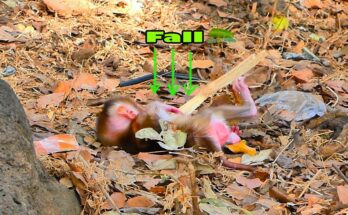
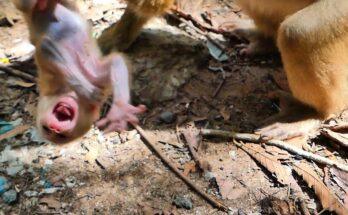
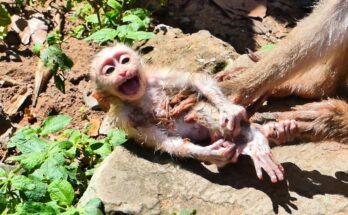
The grass near the outer edge of Angkor Wat was still damp from the morning dew when the moment unfolded.
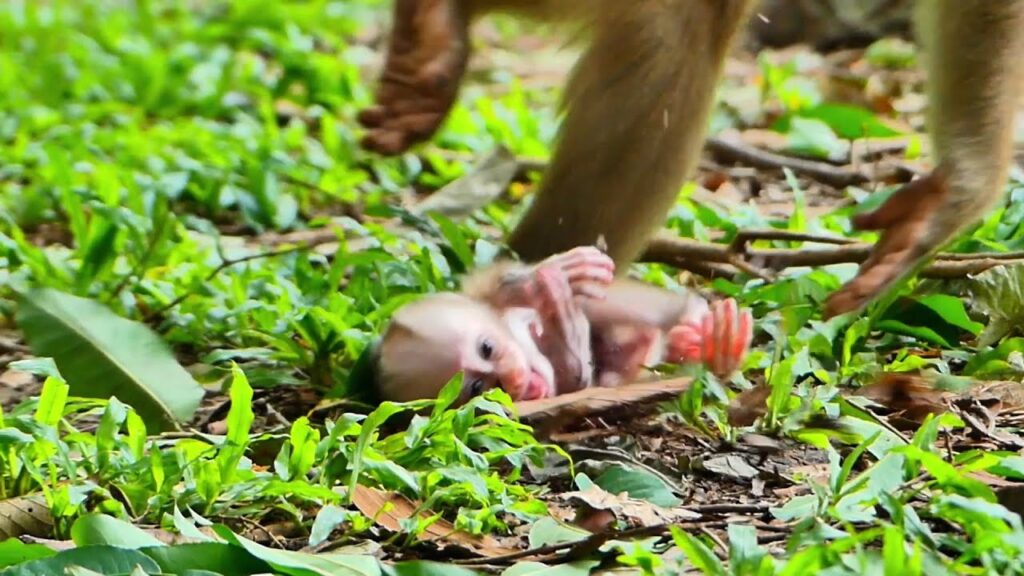
Lily had been clinging closely to Libby for most of the day. The troop moved slowly across the clearing, stopping occasionally to groom or forage. Libby stepped forward to join a small group near a fallen stone pillar.
Lily hesitated.
For the first time that afternoon, she didn’t follow immediately.
She remained sitting in the grass.
At first, it seemed like nothing more than distraction. A fluttering leaf caught her attention. A distant call from another monkey echoed softly. But when she looked up and realized Libby had moved several feet away, her expression shifted.
She let out a small cry.
It wasn’t loud. It wasn’t urgent. It was the sound of a baby noticing distance.
Libby didn’t rush back instantly. She paused where she stood, glancing over her shoulder. From where I watched beneath the shade of a tall tree, it felt less like departure and more like invitation—an unspoken encouragement for Lily to move on her own.
In American neighborhoods, parents often do something similar. A toddler hesitates at the edge of a playground. A mother steps forward just enough to say, “You can come to me.”
Lily cried again, softer this time.
Then she stood.
Her tiny legs carried her carefully across the grass, wobbling slightly but determined. Each step closed the gap between uncertainty and reassurance.
When she reached Libby, there was no dramatic embrace. Libby simply lowered herself slightly, allowing Lily to climb up against her chest.
The crying stopped instantly.
The reunion was quiet, almost ordinary.
But beneath the ancient towers of Angkor Wat, that ordinariness felt meaningful. Lily had experienced something small yet important: separation without loss.
The grass still shimmered in the afternoon light. The troop resumed its steady rhythm. And Lily clung a little more confidently than before.
Sometimes love steps a little ahead—not to leave, but to teach.