It was just after sunrise when I heard it.

Not loud. Not frantic. Just a small, searching call that carried through the tall trees behind Angkor Wat.
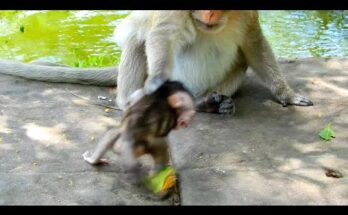
The troop had been moving steadily through the lower canopy, mothers guiding their young across tangled roots and ancient stones. But one baby lingered behind — uncertain, watching the others move ahead.
The call came again.
If you’ve ever heard a child call from another room in the early morning — not afraid, just wanting reassurance — you know that sound. It reaches something instinctive inside you.
The baby stood near a thick tree root, glancing upward. Its tiny hands opened and closed against the bark, as if unsure whether to climb or wait.
An older monkey paused several feet away, turning back.
That moment stretched.
For American readers, it might feel like watching a toddler at a park, hesitating at the bottom of a slide while a parent waits nearby. There’s courage building — but it needs acknowledgment.
The older monkey descended slowly, not urgently, just present.
The baby moved closer, pressing briefly against her side before looking outward again. The message wasn’t desperation.
It was connection.
Within minutes, the baby attempted the climb again — this time with more confidence.
And that’s what stayed with me.
Sometimes “help” doesn’t mean rescue.
Sometimes it means presence.
Under the quiet silhouette of Angkor Wat’s ancient towers, I witnessed something that felt deeply human: the simple act of staying close long enough for someone small to find their footing.
By the time the troop disappeared into the trees, the baby was moving independently — glancing back only once.
The forest returned to its steady rhythm.
But that tiny voice, and the response it received, lingered in my thoughts long after.