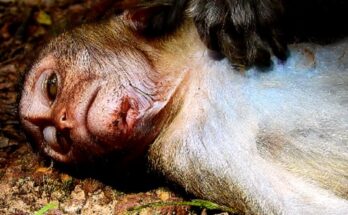
The morning air near Angkor Wat carried that familiar stillness that comes just after sunrise. Cicadas hummed softly in the trees, and a thin layer of mist hovered above the ancient stones. That’s when I noticed the young mother and her baby.

The infant was small—still unsteady, still learning how to hold on. It reached for her, searching instinctively for milk. But as it tried to nurse, the mother abruptly shifted and knocked the baby off balance. The little one tumbled onto the stone ledge below her.
For a moment, my heart tightened.
The baby scrambled back up quickly, clinging again to her side. It tried once more. And again, she pushed it away—not aggressively, but firmly. The movement was controlled, deliberate.
From a human perspective, it felt confusing. In the U.S., we’re taught that nurturing means immediate comfort. We respond quickly when a baby cries. We lean into softness. So watching this interaction felt unfamiliar.
But the forest operates on different rules.
The troop was active that morning. Other monkeys were moving nearby, including juveniles known for testing boundaries. The mother kept scanning her surroundings. Each time her baby tried to nurse, she repositioned—not rejecting, but regulating.
The infant didn’t give up. It pressed its tiny face against her again and again, determined and trusting.
Eventually, the mother climbed down from the exposed ledge and moved toward a thicker patch of trees near the temple wall. There, partially shielded by roots and shadow, she allowed the baby to latch.
The shift was subtle but powerful.
The baby relaxed almost immediately. Its small body softened against her chest. And though the mother remained alert, she no longer pushed it away.
Watching the full sequence changed everything.
What looked harsh at first was actually timing. She wasn’t denying nourishment—she was choosing a safer moment. In the wild, vulnerability has consequences. A nursing infant demands stillness, and stillness can attract attention.
As I stood there, I realized how quickly we interpret behavior through our own cultural lens. We see a push and think rejection. But in the Angkor forest, a push can mean protection.
The baby stayed tucked under her arm long after feeding. And when the troop began moving again, she carried the little one tightly against her body.
It wasn’t a lack of love.
It was love shaped by survival.