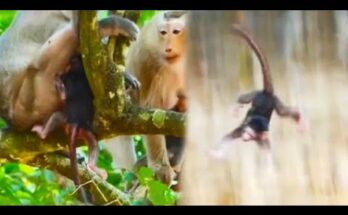
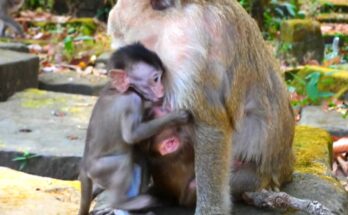
The morning air in the forest surrounding Angkor Wat always carries a certain softness. Mist lingers between ancient stones. Cicadas hum in a steady rhythm. And the macaques move like shadows across the temple walls.
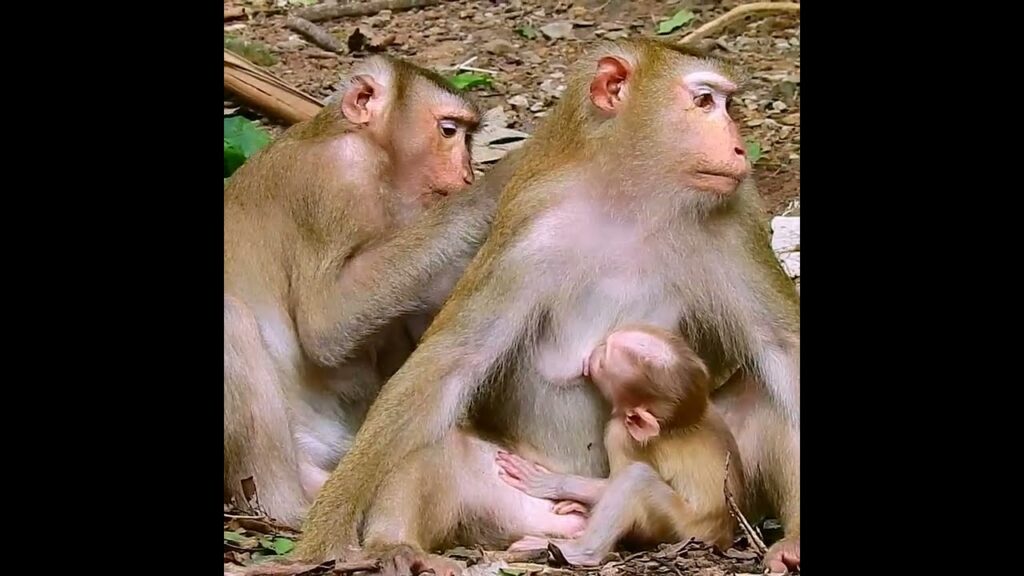
That’s where I noticed Luno.
He was smaller than the others, still carrying the roundness of infancy. His fur, slightly golden in the early light, caught the sun as he carefully approached his mother, Luna. She sat upright on a weathered stone ledge, calm and still, scanning the forest the way experienced mothers do.
Luno reached for her gently.
He made no noise at first—just a small nudge, the universal language of babies everywhere. He pressed closer, searching for milk, for comfort, for reassurance.
But Luna shifted.
It wasn’t sudden or dramatic. She simply turned her body away.
Luno paused. You could almost see the confusion settle in. He tried again, circling carefully to her other side. Another soft reach. Another quiet request.
Again, Luna moved.
There was no anger in her gesture. No aggression. Just distance.
Watching from a few yards away, I felt something that many parents in America might recognize instantly: the complicated, sometimes painful process of independence. The moment when a mother begins teaching her child that the world will not always provide comfort on demand.
Luno didn’t cry. He didn’t lash out. He sat back on his tiny haunches and simply waited.
The forest continued as usual. Tourists whispered in the background. Leaves shifted in a warm breeze. And there, on a centuries-old stone platform, a quiet lesson unfolded.
After a few long minutes, Luno stopped reaching. Instead, he looked around. He studied the older juveniles leaping across branches. He seemed to calculate something within himself.
Then he stood.
Slowly, hesitantly, he toddled a few steps away from Luna and attempted to climb a low root. It wasn’t graceful. He slipped once, regained balance, and tried again.
Luna watched from the corner of her eye.
This time, she didn’t move away.
There are moments in the wild that mirror our own lives more than we expect. For American parents balancing work, family, and the emotional pull of raising children, this scene feels familiar. Growth often begins in quiet denial—not rejection, but redirection.
Luno would return to her later. Of course he would. But that morning in Angkor Wat, he learned something small and important.
Sometimes love looks like stepping back.
And sometimes, the bravest thing a baby can do is take one small step forward on his own.