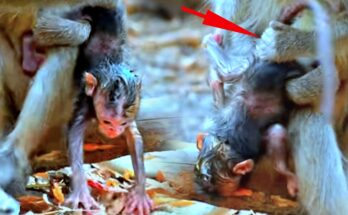
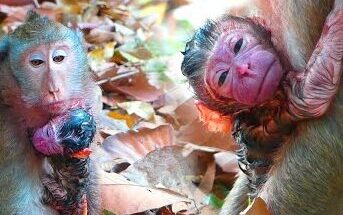
The forest was unusually still that morning near the outer stones of Angkor Wat. The air held the soft weight of dawn, and the leaves barely moved, as if the trees themselves were waiting. A young mother monkey sat low on a root near the path, her posture unfamiliar, uncertain. This was her first birth.
Her newborn lay close, impossibly small, its body not yet settled into the rhythms of the forest. New mothers often adjust quickly, guided by instinct and the quiet example of others. But this one hesitated. She touched the baby gently, then pulled her hand back, as though unsure what the moment required of her.
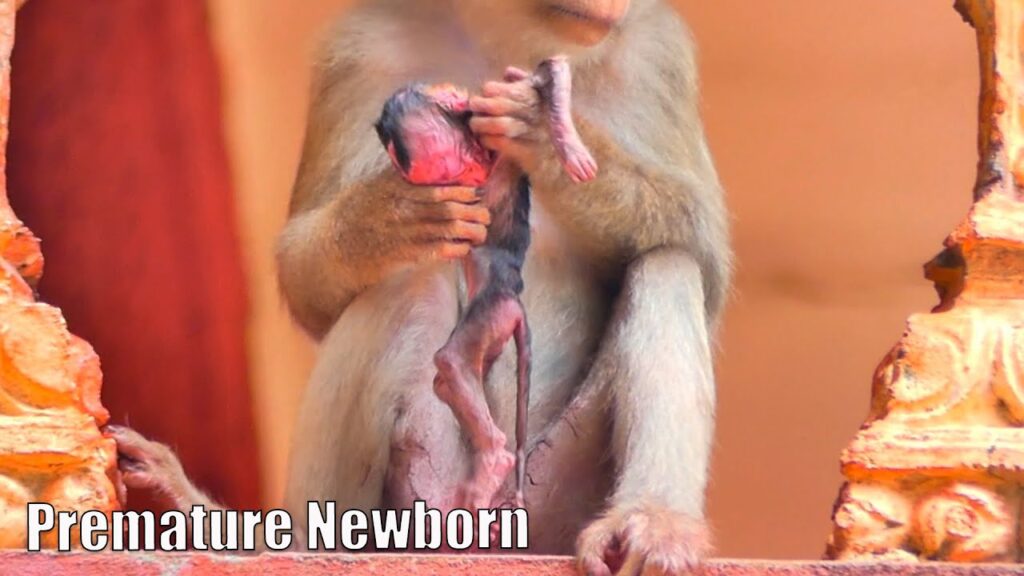
Time passed slowly. Other monkeys moved above her in the canopy, continuing their routines. No alarm was raised. Nothing dramatic unfolded. It was simply a quiet, difficult beginning.
The newborn did not stir. The mother shifted her weight, then leaned forward again, watching closely. She nudged the tiny body once, softly. Then she waited. In the forest, waiting is often an act of hope.
There are moments in nature that feel deeply human, not because animals mirror us, but because we recognize the same uncertainty. This was one of those moments. The mother’s eyes stayed fixed on the newborn, her expression unreadable but intent. She did not leave.
As the light strengthened, it became clear that this beginning would not become a future. The baby never took its first strong movement. The mother remained beside it longer than expected, touching, pausing, sitting back, then returning again.
Eventually, instinct guided her elsewhere. She moved slowly into the trees, glancing back once before disappearing into the leaves. The forest resumed its sound.
Nothing about the scene asked for attention. Yet it stayed with those who witnessed it. A first lesson, learned too early, in a place where life often begins loudly—but sometimes does not.