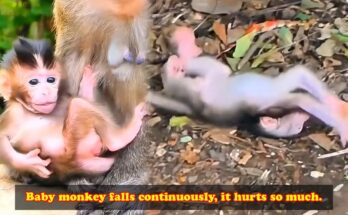
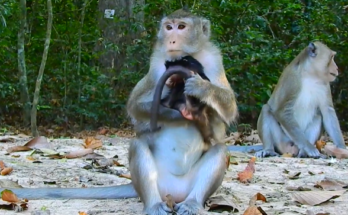
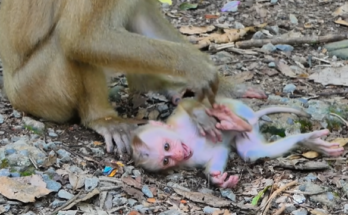
I still remember that morning like it was yesterday — a sun-drenched dawn in the Angkor forest, where the rays of light cut through vines and moss that draped the ancient stone like a sacred tapestry. I had arrived at Bayon Temple just as silence was giving way to the chatter of birds and the distant hum of arriving tourists. But nothing could have prepared me for the sound that pierced that calm: a sharp, terrified squeal echoing off the centuries-old carvings.
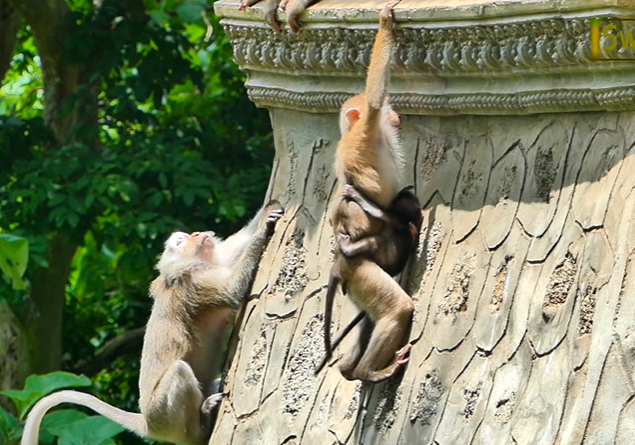
At first I thought it was a startled tourist, but then I saw her — a tiny baby macaque, fur matted with dust, eyes wide with fear as she clung to the edge of a slightly weathered sandstone ledge. Moments before, she had been snatched from her mother’s side, dragged by someone chasing a viral video moment. It was a moment that would break my heart.
The forest around us seemed to hold its breath.
People were filming — not to help, but to capture every second for views and likes. I watched in horror as the baby’s hold slipped, and she fell toward the earth below — not into the welcoming brush of the jungle, but into the unforgiving emptiness between human entertainment and her natural world.
I sprinted forward, my heart hammering, praying she’d be unharmed. There she lay — trembling and alone — tiny hands and feet curled toward her chest. The crowd gathered, phones raised, lenses trained, yet no one reached out. Not even her would-be rescuer, more interested in filming a “viral moment” than saving a life.
I dropped to my knees beside her. Her dark, fearful eyes met mine — ancient, wise, and somehow understanding. In that gaze I saw the jungle: her home stolen, her family gone, and her trust broken by human hands.
My pulse raced with equal parts fear and compassion.
I scooped her up gently, feeling the fragile tremor of her body against my palms. No one spoke. Only the whisper of wind through the trees bore witness to what had just happened.
Her tiny heart beat rapidly, but she didn’t cry. Her strength — even in pain — was astounding. I pressed my shirt beneath her, shielding her from the blazing Cambodian sun that now climbed high overhead.
I remembered the warnings from local wildlife protectors — how irresponsible interactions, feeding, and forced handling were not only altering these wild creatures’ behavior, but placing them in harm’s way. Tourists feeding bananas, cameramen crowding around troops, and the dangerous trend of taking baby monkeys away from their mothers for content had pushed these animals into conflict with humans.
As hours passed, her condition seemed to stabilize. The forest — once just a backdrop — now felt alive with urgent energy. Birdsong and rustling leaves were her lullaby and alarm. I spoke softly, like one would to a frightened child, promising her that she was safe. That she had not been forgotten.
I stayed with her until a local wildlife rescue volunteer — who had been called by concerned travelers — arrived. He cradled her with reverence, promising to take her to a sanctuary where injured and displaced animals could heal and return to their natural habitat.
The moment he lifted her from my arms, I felt a sting of loss and relief — gratitude that she was going to be cared for, sorrow that her story started in fear.
Yet this one tiny creature, who should have been with her mother in the lush canopies of Angkor’s forests, now stood at the crossroads of cruelty and compassion. Her survival — at least for now — relied not on viral clicks, but on humanity.
As I walked away that day, I made a vow: to share her story — truthfully, tenderly, and with deep respect for what we often take for granted.
Because sometimes, a single moment — a fall, a frightened glance, a hesitant breath — is all it takes to open a heart.