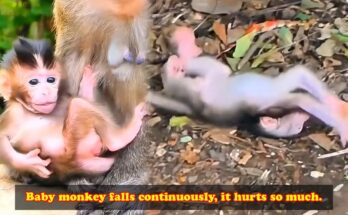
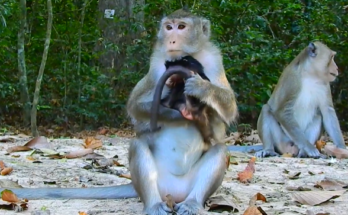
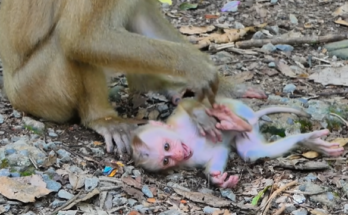
The first thing you notice about the Angkor Wat forest at dawn is how alive it feels — not loud, but breathing. Ancient trees stretch their roots into moss-covered stone, birds whisper secrets from branch to branch, and somewhere deep within that quiet, Ara’s story began.
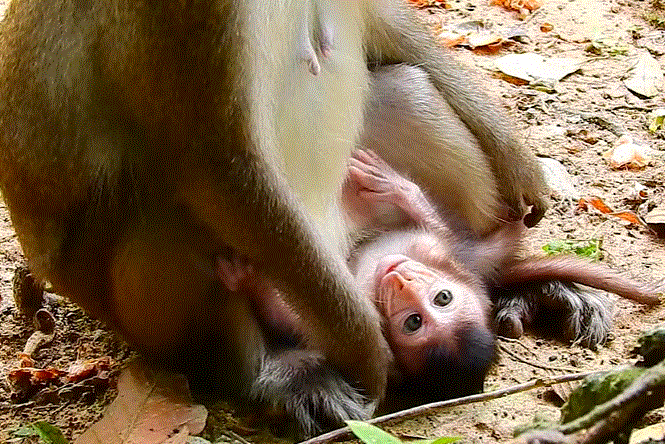
I remember the moment I first saw her.
She wasn’t playing like the other young monkeys. She wasn’t chasing leaves or climbing vines. She was small, tense, and alert — her tiny hands gripping whatever she could reach, as if the world itself felt unstable beneath her feet.
Ara was hyper, yes — constantly moving, constantly searching — but not in the way people assume. This wasn’t playful energy. This was fear wrapped in motion.
When we offered her milk, she latched on immediately, clinging to the teat with an intensity that surprised everyone. She didn’t just drink — she stayed. Her body pressed close, her eyes half-closed, her breath slowing for the first time since we’d found her.
Some whispered that she was spoiled.
That she wanted too much comfort.
That she should learn independence.
But standing there, feeling her tiny fingers tighten whenever someone stepped away, I knew the truth.
Ara wasn’t spoiled.
She was scared of being alone.
In the wild, belonging is survival. For a baby monkey, separation isn’t just emotional — it’s life-threatening. And something in Ara’s early days had taught her that safety could disappear without warning.
So she held on.
Day after day, Ara followed us everywhere. If someone stood up, she scrambled after them. If the milk bottle moved, she reached. When we tried placing her down to explore on her own, she returned instantly, pressing herself against warmth, against presence, against reassurance.
And slowly — something changed.
Her hyper movements softened. Her eyes no longer darted in panic at every sound. She began to explore the forest floor, touching leaves, sniffing bark, listening to insects — but always within sight of us. Always close enough to return.
Trust, I learned, doesn’t arrive all at once.
It grows in layers.
One afternoon, the forest was unusually quiet. Sunlight filtered through the canopy, warming the ground where Ara sat beside me. She drank her milk slowly, then surprised us all — she stopped, looked up, and rested her head against my arm.
No grasping.
No clinging.
Just presence.
That was the moment I understood.
Ara didn’t need constant feeding.
She needed confirmation.
She needed to know that when she let go, something — someone — would still be there.
Many people who watched the video later commented that Ara seemed “too attached.” But those who have known loss recognize the signs immediately. When you’ve experienced abandonment — whether human or animal — you don’t stop needing comfort. You need proof that connection is real.
Ara taught us that belonging isn’t about independence.
It’s about having a safe place to return to.
As days passed, her confidence grew. She climbed higher. She wandered farther. She played more freely. And yet, every evening, she returned — curling close, calm and content, no longer frantic.
She had learned something powerful.
She belonged.
Not because we forced her to stay.
Not because she was fed.
But because she was seen.
In that ancient forest, surrounded by ruins that have outlived empires, a tiny monkey reminded us of something deeply human: that love is not weakness, and closeness is not spoiling.
Sometimes, holding on is how healing begins.
And sometimes, the smallest creatures teach us the biggest truths.