In the early morning hush of Angkor Wat’s ancient forest, I first saw him: a lone young macaque with soft, curious eyes that glinted in the dawn light. He sat perched on a mossy stone, the temple ruins looming behind him like silent sentinels. His fur — once dusty brown — had begun to shine; it was as though something inside him was changing.
This was not just another forest monkey. I felt it deep in my chest: he was destined for more.
Weeks earlier, this young macaque had been one of many—scrambling for scraps, foraging in the undergrowth, always on edge. But something shifted when a few YouTube creators started coming into the forest, luring the troop with bananas, milk, flashes, and cameras. Their well-meaning but reckless feeding was creating a dangerous dependency. Over time, the wild monkeys stopped foraging as instinctively, waiting instead for the tourists to produce food. According to the Apsara National Authority, this kind of repeated human interaction has changed their natural behavior.
One morning, I watched as the young macaque hesitated at the edge of a group of tourists. His heart pounded, yet his gaze stayed fixed on a banana someone dangled. He leapt with grace, grabbed it, and froze for a moment — triumphant and scared all at once. That was when I realized: this was his moment of transformation.
After that, I started seeing him differently. He ventured deeper into the forest, still returning for food, but also exploring. He was learning to balance two lives: one shaped by humans, one born of the forest.
One evening, twilight settled over Angkor Wat, casting long shadows through the trees and along the time-worn stones. He sat alone on a fallen carving, cradling a small piece of fruit. The temple walls around him resonated with centuries of history. In my mind, he wasn’t just a monkey anymore — he was a king, perched on a throne of stone, surveying his kingdom.
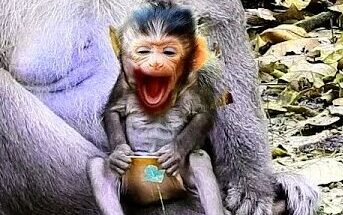
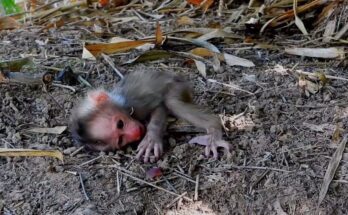
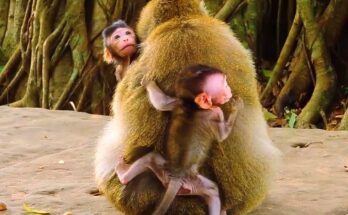
But his rise wasn’t easy. There were moments of violence, too. The troop was fragmented, in part because of unnatural feeding practices. Video operators chasing monkeys, pushing them into dramatic scenarios, even separating mothers from infants — these behaviors disrupted the macaque social structure. Some video crews abandoned previously domesticated monkeys into the wild. I heard the whispers of this crisis in the forest, the rustling branches and the sorrow in the mothers’ calls.
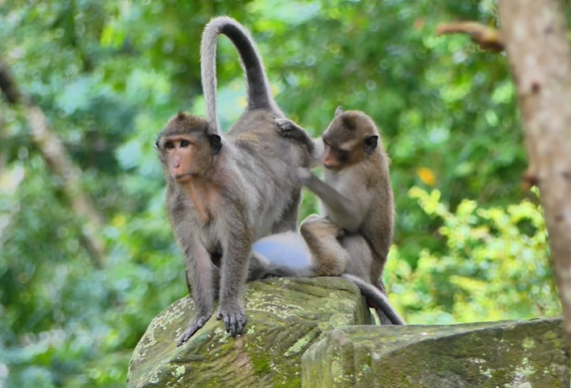
Yet, the young macaque persisted. He became bolder, but not cruel. He defended smaller monkeys, shared food when he could, and sometimes stood guard when the troop slept under the canopy. I watched him groom another macaque with gentle care, the way a true leader would.
One day, a group of tourists laughed, pointing their cameras at him. He raised his head, scanning them, and for a heartbeat I swear he looked at me — not as prey, but as a subject. I felt a lump in my throat. This wasn’t just a viral video in the making; this was a life being reclaimed.
But tragedy lurked. The Apsara National Authority has warned that some of these monkeys have become aggressive. There have even been bites, and damage to precious temple stones. The feeding and filming machine that raised him also threatened his home. One wrong move, one careless tourist — and everything could fall apart.
In the stillness of one particularly haunting dawn, I saw him alone again. His face was smeared with dawn’s light and resolve. He climbed to a high ledge of a crumbling tower, surveyed the forest and the temple below, and let out a sharp, clear call — not a frightened squeal, but a proclamation.
That call echoed off the stones. In that instant, I believed he was more than a monkey. He was King Monkey.
In his new life, he bridged two worlds: the forest and human fascination. He carried the weight of ancient stones on his back, and yet he held hope in his eyes. I felt both privileged and heartbroken to be his witness.
As I walked away later, beneath towering kapok trees and the quiet hum of insects, I whispered a promise: I would tell his story. Not just as viral content, but as a call — to protect him, to respect him, to let him be wild, to let him rule his forest kingdom.