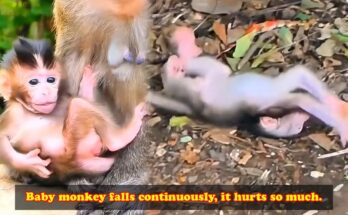
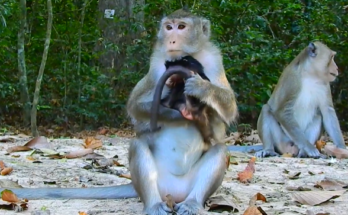
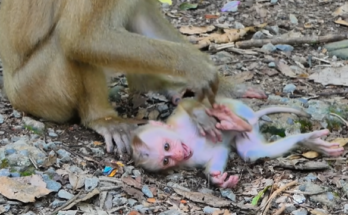
The Angkor Wat forest carries a silence that feels alive.
Not empty — but watchful. Ancient trees lean inward as if listening, and the ruins beneath them seem to remember every story ever lived here. That was where I stood when I first noticed Sweet Pea.
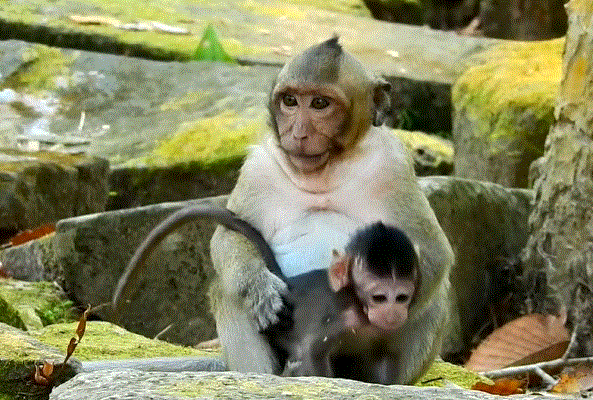
She was bigger than most babies her age, with curious eyes and restless hands that never stopped reaching. Hunger has a way of doing that — it turns stillness into motion, patience into urgency. Sweet Pea wasn’t crying yet, but her body spoke clearly. She wanted milk. She needed comfort. She needed her mother.
Her mum sat just ahead of me, shoulders curved protectively, eyes scanning the forest with quiet alertness. She had the look of someone who had already fought many unseen battles — not loudly, not dramatically, but with endurance.
Then everything changed in a blink.
A sudden movement — sharp, fast — cut through the calm. A macaque locals call PopEye lunged forward, teeth flashing. It wasn’t a full attack, but it was enough. Enough to frighten. Enough to shock. Enough to push a fragile moment into danger.
Sweet Pea startled and stiffened. Her face tightened in confusion before fear could even arrive.
Her mum reacted instantly.
She pulled Sweet Pea close, turning her body into a shield. Her voice rose — not in panic, but in warning. The forest echoed with it. That sound wasn’t anger. It was instinct. It was the sound of a mother drawing a line between her child and the world.
PopEye retreated, but the damage was done. Sweet Pea’s calm was gone. Her hunger, already heavy, now felt unbearable. She squirmed, cried, and twisted — a big baby overwhelmed by too many feelings at once.
Hunger does that to children.
Fear does that to mothers.
I watched as Mum tried to soothe her, rocking gently, whispering softly, brushing little fingers across Sweet Pea’s cheek. But milk was delayed, and Sweet Pea didn’t understand why comfort had rules.
She cried harder.
That cry didn’t just fill the air — it pulled at it. The kind of sound that makes your chest tighten, even if you don’t share the language. In that moment, Sweet Pea was every child who has ever wanted safety, warmth, and reassurance all at once.
Mum finally found a quiet place beneath a tree root curved like an open arm. She sat, steadied her breathing, and prepared to feed her child. The tension drained slowly, like water sinking back into the earth.
When Sweet Pea finally latched, the change was immediate.
Her body softened.
Her hands unclenched.
Her cries faded into small, satisfied sounds.
Milk wasn’t just food — it was peace.
I realized then how close hardship always is in the wild, even in moments that seem gentle from a distance. The Angkor forest isn’t cruel, but it is honest. It doesn’t protect the weak — it reveals who will fight for them.
Mum stroked Sweet Pea’s back, eyes still alert, never fully resting. Love doesn’t sleep here. It watches. It waits. It stands ready.
As the light shifted through the leaves, I felt something inside me shift too. This wasn’t just a scene I witnessed — it was a reminder. Of how fragile life is. Of how powerful care can be. Of how motherhood, in any species, carries the same quiet heroism.
When they finally stood to leave, Sweet Pea calm and milk-drunk, Mum nodded once — not to me, but to the path ahead.
The forest closed behind them, holding their story like it has held so many others.
And I stood there, knowing I had just witnessed something ancient, tender, and real.