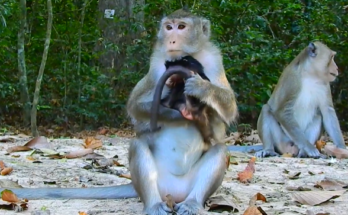
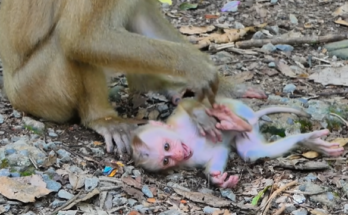
In the early morning quiet of the Angkor Wat forest, when the stones are still cool and the air feels soft enough to breathe in deeply, I found myself watching one of the tiniest fighters I’ve ever met—Baby Ara.
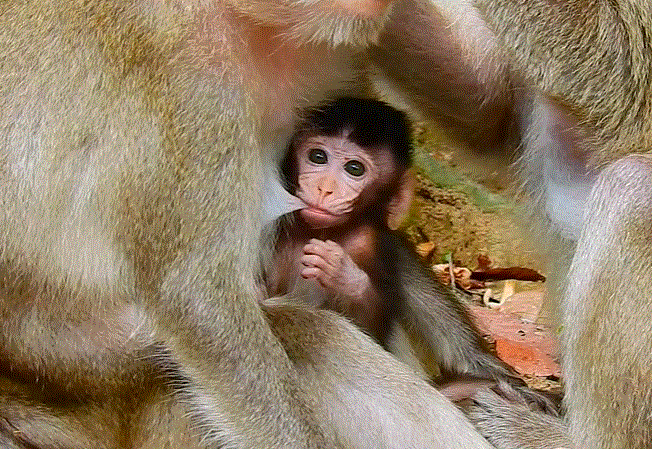
He was small, fragile-looking, with fur still soft like new moss, and eyes that reflected everything: fear, confusion, hope, and a spark of something stronger than anyone expected. That spark, I would later learn, was the very reason he survived his toughest morning.
Ara had been struggling. His mother, still adjusting to motherhood, wasn’t always patient with him. She loved him deeply—anyone could see that—but surviving in the ancient forest brings out pressure even in the gentlest mothers. Some mornings, she pushed him away when he asked for milk at the wrong time. Some days, she climbed too quickly, forgetting that his new little legs could barely hold balance.
But on this morning, everything changed.
The sun had just started pulling gold through the tall trees when Ara tried again to follow his mother. She climbed a thick, angled root, moving fast. He slipped behind her—tiny fingers gripping rough bark, too determined to cry for help. When his back paw missed its hold, he slid, tumbling into a soft pile of dried leaves.
He didn’t scream. He didn’t whimper.
He simply blinked, shook his head, and stood back up.
I remember whispering to myself, “You’re okay, little one. You’re going to be just fine.”
And somehow, he seemed to hear it.
Instead of giving up, he scrambled right back toward the root. This time, his mother turned her head. She paused—just long enough for Ara to catch her tail, just long enough for her eyes to soften.
It was the moment everything shifted.
When she pulled him close, pressing him into her warm chest, he melted against her. His claws curled into her fur. He finally felt safe. And in that soft, private moment between mother and child, I realized something important:
Ara wasn’t fragile—he was learning.
And his mother wasn’t neglectful—she was adjusting too.
The forest has its own language, its own lessons, and not all of them are gentle. Ara needed time to grow into his tiny body. His mother needed time to grow into her giant responsibility. And both were doing their best.
Watching them move together again—slowly this time, like she understood he needed patience—felt like watching a bond stitch itself stronger.
Later, Ara finally found his confidence. He started bouncing around roots and rocks, grabbing at branches, testing everything. Even the small things felt like victories: balancing on a stump, landing a little jump, reaching for his mother’s fur.
I could feel my own chest tightening with pride for a baby that wasn’t mine, in a forest that didn’t belong to me. But those moments—those small, precious victories—connect all of us, no matter where we’re from.
And maybe that’s why Ara’s story touches people so deeply.
In a world where everything moves too fast, Baby Ara reminds us that growth happens one shaky step at a time. That adjusting is hard—but possible. That strength can fit inside even the smallest body, even the quietest heartbeat.
As the day ended, Ara lay curled in his mother’s lap, breathing softly against her. She groomed him with slow, gentle strokes—nothing rushed, nothing rough. She held him like she knew he needed reassurance, perhaps for the very first time.
And in that moment, he looked up at her, eyes shining with a peace he didn’t have earlier that morning.
Baby Ara will adjust.
Baby Ara will thrive.
Baby Ara is strong—stronger than anyone ever guessed.
And as I walked away from the clearing, I realized he had taught me something too:
Sometimes you don’t need to be big to survive.
You only need to keep trying… one tiny, determined step at a time.