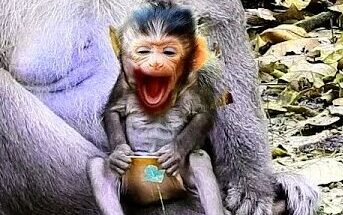
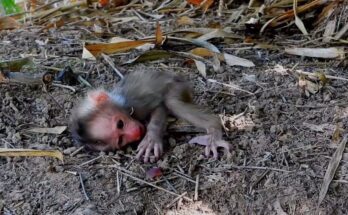
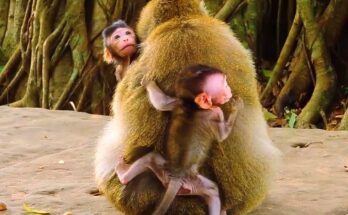
The early morning mist curled like ghostly silk around the ancient stones of Angkor Wat, wrapping the forest in a soft hush. I stepped carefully between thick tree roots and crumbling walls, my heart racing, because I heard something I wasn’t expecting: a little, trembling cry — thinner, quieter than the usual chatter of macaques, but full of a deeper ache.
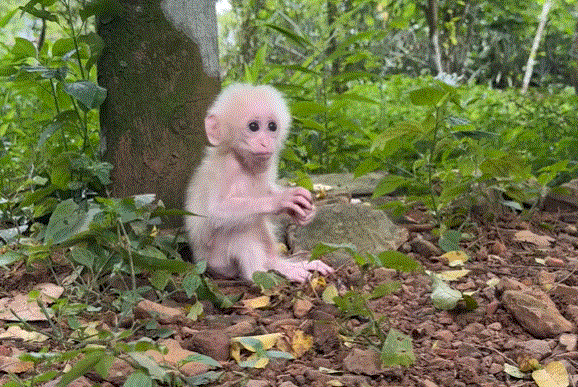
I followed it, weaving through vines and mossy benches, until I came face‑to‑face with a tiny baby monkey. He was sitting on a low stone ledge, his soft fur ruffling in the breeze, but his posture was tense. His arms hugged himself, as though trying to summon warmth. His eyes were wide and shimmering, his gaze darting through the forest, scanning, always scanning for someone he knew.
It wasn’t just hunger I sensed in him. It was loneliness — pure, raw longing. The forest around him was beautiful: dappled sunlight, mossy stones, distant birdsong — but for him, none of it felt safe or familiar. He called out again, a soft whimper that rose into a whine, and it echoed, oddly, against the ancient Khmer architecture: as if his voice knew it was being witnessed by something timeless.
I froze, unsure whether to stay or retreat. I didn’t want to startle him, but I couldn’t leave without watching over him, at least for a moment. So I crouched at a respectful distance, camera in hand, not to capture a viral shot, but simply because I needed to bear witness to his hurt.
Minutes passed, and still no mother came. He tilted his head, listening. His breathing grew shallower, more ragged. Every so often, his little chest rose and fell, but his energy was fading.
In that moment, I couldn’t help but feel a deep connection. It’s hard to explain — but I felt what so many human parents feel when a child is upset and alone. That desperate, helpless instinct to pick him up, wrap him close, whisper that everything would be okay. But this wasn’t my world, and I was just an observer.
Then, from somewhere deep in the forest, I heard it: a distant call. Higher-pitched, urgent, motherly. It sliced through the silence like a song. His ears darted toward it. His body stiffened. And then… hope.
He stumbled forward, tiny legs shaking as he ran, as if his heart had suddenly remembered how to beat louder. My breath caught. I watched, nearly holding mine.
Then she appeared: a female monkey, cautious at first, stepping between the shadows of stone and roots. Their eyes locked, mother and child, both trembling. And then she moved — not with hesitation, but with purpose.
When they touched, it was almost silent. She reached out, delicate fingers brushing his fur, sniffing, scanning, confirming. He leaned in, pressed his head to her chest, and she wrapped him in an embrace so instinctive, so tender, that I felt tears prick my own eyes.
For a long moment, they stayed like that. The forest seemed to slow down around them. The wind softened, the birds quieted, even the crumbling stones felt like they paused in reverence. The baby monkey nuzzled, his breathing steadying. The mother pressed her cheek against his head, rubbing gently, deeply, like she was making up for every second she’d been absent.
I didn’t lift my camera for a while; I just watched. I realized then: this wasn’t a spectacle. It was a sacred moment — the most primal, honest thing you can witness in the wild: a mother and her child, reuniting.
After some time, she stood and carried him carefully, his arms curled around her neck, his legs gripping her side. He was heavy with relief, with gratitude, with the unspoken “thank you” that is felt, not spoken.
We walked together, through the forest, past mossy stones and over roots, until they melted back into the troop. I stayed rooted for a moment, letting the weight of what I saw sink in.
I left Angkor Wat that morning feeling different. The temples, the ruins, the history — they all felt alive in a new way. Because I’d seen life’s tenderest pulse: the bond between a mother and her baby, stronger than ancient stones, more enduring than silent shadows.
Watching that little monkey wait, calling out until his mother came back — it reminded me that in nature, as in humanity, love isn’t always easy, but sometimes it’s enough to heal the deepest loneliness.