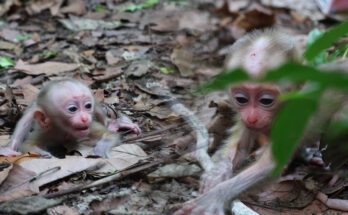
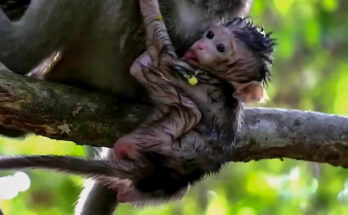
The morning I noticed him, the mist was still sitting low between the trees near the eastern causeway. It was the kind of quiet that makes Angkor Wat feel like it belongs to a different century — and maybe it does. The long-tailed macaques were already moving through the upper branches, the adults grooming each other in the first warm patches of sunlight filtering through the canopy.
That’s when I saw him. He was on the stone path, not moving. So small he could have been a fallen leaf.
He was a newborn — maybe a day old, maybe less. His eyes were sealed tight, his fur still damp and matted against his thin body. He made no sound at all. Nearby, the troop carried on as if he weren’t there. His mother was gone — whether she had moved on or simply couldn’t care for him, there was no way to know. The forest doesn’t always explain itself.

A local caregiver who monitors the troop noticed him within minutes. There was no dramatic intervention — just a quiet, steady presence. She knelt down slowly, let him catch her scent, then gently wrapped him in a soft cloth. He didn’t resist. He was too tired, too new to the world to resist anything.
The milk came from a small bottle — warm, diluted just right for a newborn primate. He latched on slowly at first, then with surprising determination. His tiny fingers wrapped around the bottle like they knew exactly what they were holding.
Over the next few hours, something shifted. He stopped being a small still thing on a cold path and started being something with a future. He stretched. He gripped. He made small sounds that hadn’t been there before.
The troop moved deeper into the forest as the afternoon heat settled in. But he stayed close to his caregiver, sleeping against her warmth in the shade of a thousand-year-old wall.
Not every story in this forest is dramatic. Some are just quiet, and small, and full of meaning anyway. This one was all three.