Something felt different the moment I spotted him.
Most mornings along the stone paths near the eastern gallery of Angkor Wat, the young macaques move fast — bouncing between roots, chasing each other over moss-covered walls, never still for more than a few seconds. But this little one wasn’t moving at all.
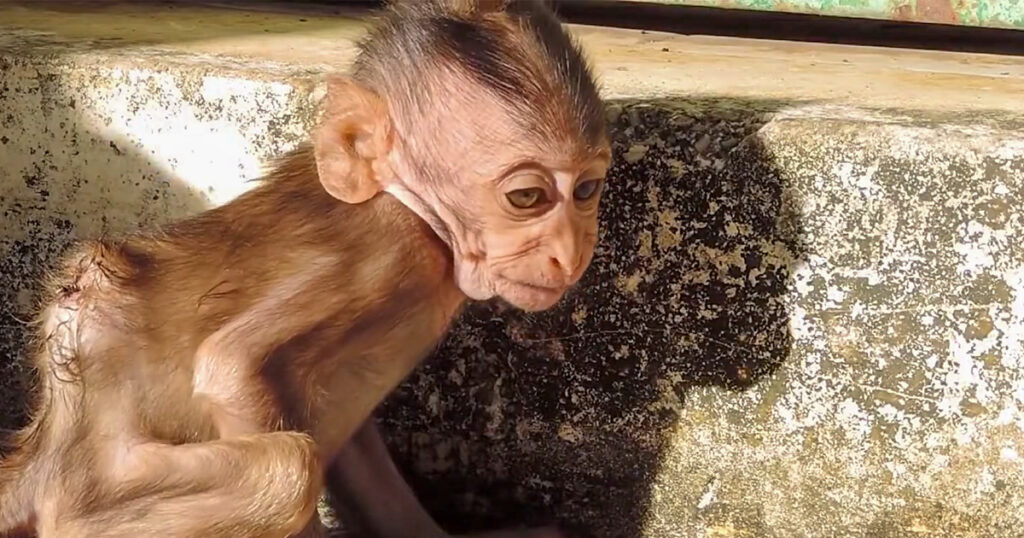
He was sitting low on a thick tree root, hunched slightly forward, his small arms tucked close to his sides. His tail curled inward rather than arching up the way healthy juveniles carry theirs. Every few seconds, he let out a soft, broken call — not loud, not urgent, just tired and steady, like someone who had already been hurting for a while.
His back was the problem. I couldn’t know exactly what had happened — a fall, maybe, or a rough tumble during the kind of play that young males throw themselves into without thinking. Whatever it was, the injury was clear in the way he held himself: careful, protective, like he was afraid to shift his weight.
What happened next stopped me completely.
His mother came from above — dropping down through the canopy in that fluid way macaques move when they’re not playing around. She didn’t pause to look around. She went straight to him, her eyes fixed on his face the way only a mother’s eyes move. She pulled him in close, wrapping both arms around him in a hold that looked less like grooming and more like an embrace.
He pressed his face into her chest. His calling stopped.
For several minutes, neither of them moved much. She groomed the fur along his spine with slow, careful fingers, pausing whenever he flinched. He leaned into her harder each time she did. The forest kept moving around them — other macaques passing, birds shifting in the canopy overhead — but those two stayed still in the middle of all of it.
I’ve spent a lot of mornings in this forest. I’ve seen macaques fight, play, steal food, and ignore each other completely. But I’ve never stopped believing that what a mother does for her young one, in a quiet moment by an ancient stone wall, is something worth paying attention to.
He was still hurting. But with her there, he wasn’t alone in it.