I still remember the first time I saw them — Mom Nanda and her newborn daughter, Baby Naina — walking slowly through a narrow footpath in the forest near Angkor Wat, Cambodia. The early morning light filtered through the ancient canopy, casting dappled golden beams across the leaves. It felt like the forest itself was holding its breath, blessing this fragile new life.
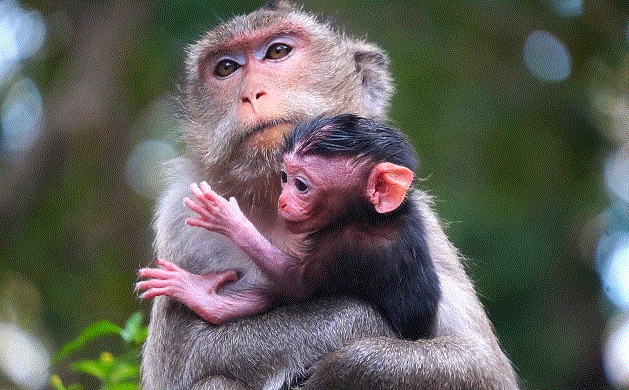
Mom Nanda moved with a quiet reverence. She cradled Naina close to her chest, swaying gently as if to the breath of the forest itself. I watched as a tiny hand curled around her finger, and in that instant I realized: this was more than just a mother and child — this was hope.
They had arrived just after sunrise. The smell of damp earth and moss hung in the air, mingling with the faint scent of lotus from a nearby pond. As she laid a thin cotton blanket on the ground — softened by years of sun and care — Mom Nanda sat under the shadow of a great tamarind tree. She hummed softly, a lullaby in Khmer that must have been older than many of us. Baby Naina stirred, her eyes fluttered open, and in the hush, I felt the forest’s heartbeat slow to match hers.
From the first feed to the first gentle burp, everything Mom Nanda did seemed to carry an unspoken vow: to protect, to nourish, to love. She brushed aside a stray strand of hair and whispered encouragements as she positioned Naina for just the right latch. Naina’s tiny lips parted — slow, hesitant — then latched. The forest sighed, and a soft breeze rustled through the leaves, as if nature itself exhaled in relief.
As the hours passed, Mom Nanda’s tenderness didn’t wane. She cleaned Naina’s skin with water harvested from a bamboo well nearby — cool, pure, and sacred. She changed her gently, always speaking softly, her voice full of warmth and reverence. The forest around them seemed to draw closer, enveloping mother and child in an embrace older than stone.
I sat not far, watching, listening. I didn’t take a photo. I didn’t want to disturb the quiet magic. Instead, I soaked in the scene — the gentle rise and fall of Nanda’s chest, the tiny yawn of Naina, the way the morning light danced across their faces.
Hours turned into afternoon, and the golden light deepened, turning the forest into a cathedral of green and gold. A distant bird called, and Naina stirred again as if answering. Mom Nanda lifted her, holding her up to the light. I saw Naina’s eyes — dark, curious — squinting against the brightness. And then she blinked, and for a heartbeat, it felt like the whole world paused.
I wondered what she saw in that moment. Maybe she saw the leaves dancing. Maybe she sensed the forest around her. Maybe — just maybe — she sensed love.
By the time the sun dipped low and shadows stretched long across the earth, Mom Nanda gently laid Naina down on the blanket for a nap. She brushed a stray leaf away, tucked a tiny palm leaf over her — a soft, improvised shade. Then she sat back, leaning against the tamarind tree, gazing at the sky turning lavender.
Tears gathered in my eyes. Not tears of sadness, but of awe. Here, under these ancient trees, in land where history is carved in stone, new life was being welcomed with open arms — with the purest form of love.
In those hours, I witnessed more than just care. I witnessed a mother’s promise. I witnessed roots reaching deep into the earth, interwoven with hope. I witnessed life beginning anew — fragile, glowing, resilient.
If you ever doubt the quiet power of love — the kind that doesn’t shout, doesn’t demand, but simply is — remember Mom Nanda and Baby Naina, in the forest near Angkor Wat. Because love doesn’t always arrive with fanfare. Sometimes, it arrives softly, under ancient trees, in the hush of dawn.