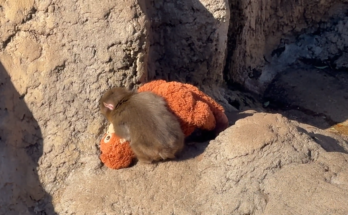
I still remember the morning I found Lora, curled under the huge roots of an old banyan tree, the moss damp under my palms. Light filtered through the ancient canopy of the Angkor Wat forest in gentle, trembling beams as if the temple stones themselves were holding their breath. And there she was — Lora, a mother macaque, her eyes soft, her body trembling with what looked like shame.

Beside her, on the forest floor, lay her baby. Tiny. Vulnerable. Unmoving. My heart tightened. I thought she was just resting him, but then I saw the way she backed away, stepping lightly, not reaching for him. My breath caught: she was leaving.
Lora had always been attentive, protecting her little one as they navigated the roots and mossy stones. But on that day, something had changed. A disturbance rippled through the troop — other monkeys, tourists nearby, camera flashes from YouTube creators, as I later understood . The forest, usually a refuge, turned loud, intrusive.
I watched Lora hesitate, her body stiff. Her baby opened his eyes wide, but she didn’t comfort him. Instead, she turned, almost silently, and walked away. The little monkey let out a quiet cry, so soft it nearly blended with the rustling leaves. I knelt beside him, my hand hovering, but I didn’t dare pick him up. I couldn’t disturb the fragile moment more than it already was.
As Lora’s silhouette receded deeper into the forest, I followed, not to intrude, but to understand. Why would she walk away? Angkor’s forest felt ancient, wise, and I felt like an outsider to this heartbreak.
After a few paces, she stopped, sat beneath a ruined sandstone wall carved with age-old patterns, and turned to look back. Her chest heaved. Her eyes flickered over to her baby, then away. I saw guilt, confusion, and something deeper — fear. Fear of the growing crowd, fear of the constant filming, fear that the forest was no longer hers alone.
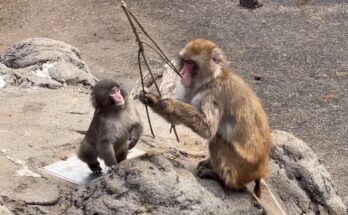
Back on the ground, the baby monkey shivered in the early sun. I saw his little limbs stretch, his chest rise and fall with shallow breaths. I stayed, powerless, until another older female from the troop emerged. Her name — I felt — could have been Suri, though I could not be certain. Without a word, she approached the baby, arms gentle, grooming him softly. She cradled him. Lora watched from a distance, tail curled, her gaze sorrowful.
The older female did not scold, she didn’t judge; she simply held. And her care was fierce and loving, as if she was saying, “I will be your mother now, if she will not.” Lora remained on the fringe, eyes downcast, as though ashamed.
I felt tears burn in my throat. In that sacred forest, the ancient stones bore witness to a story as old as time — of betrayal, abandonment, and unexpected compassion.
I realized then that Lora’s choice wasn’t born from cruelty, but from desperation. The crowd of YouTubers — not aware of the damage they caused — had changed the forest’s rhythm. Authorities even opened investigations into how these cameras were pressuring the monkeys and disturbing their natural life.
Later, I returned to check. The baby was safe with Suri. Lora was nearby, still watching, but not touching. Whether she ever regained the courage to take him back — I couldn’t know. The forest held its secrets.
What stayed with me was how fragile love is, how easy it is to let go when fear takes hold. But also, how kindness can rise when someone steps in — even in a world ruled by ancient stones and modern lenses.