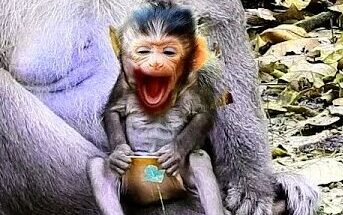
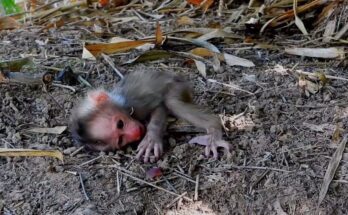
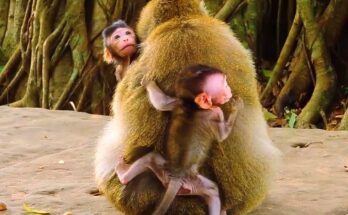
It was early morning in the forest around Angkor Wat — the golden light of dawn spilled over ancient temple stones, and the morning mist curled between moss-draped roots. I had come here, camera in hand, expecting to witness quiet macaque troops playing among the temple ruins. But nothing prepared me for what happened next.
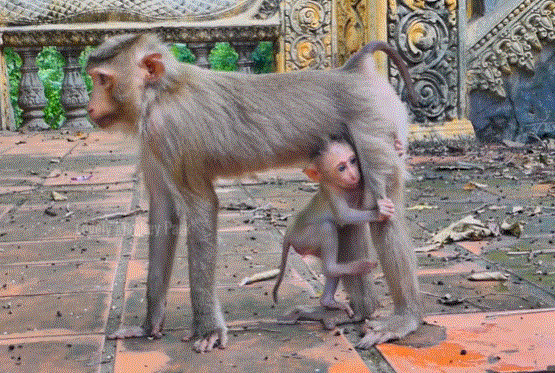
I remember when I first saw her: a baby monkey, no bigger than my hand, perched hesitantly at the edge of a clearing, her wide eyes reflecting both fear and wonder. She was separated from the dense green shadows of the forest, stepping into a patch of sunlight for the very first time. Behind her, her mother watched close but gave her space, as though encouraging her without pushing.
My heart thudded. This moment felt sacred — fragile and full of promise.
She took a tentative step forward, balancing on a thin branch, her little tail flicking behind. She paused, looked around, as if measuring the distance between her old life and this new space. The forest was alive with rustling leaves, chirping birds, and distant temple bells — a lullaby of ancient stone and living green.
Then she leapt — just a small jump — and landed on a sunlit patch of ground. She sat there a moment, blinking, absorbing everything: the warmth of sunlight, the soft breeze, the scent of earth and stone. Her chest rose and fell, and I swear I saw a quiet triumph in her little face. The world had opened up to her, and she was meeting it with curiosity.
I couldn’t move, didn’t want to disturb her. The forest felt hushed, watching with me. And then she scampered — first toward a low wall covered in lichen, then to a stone pillar. She climbed, wobbly but determined, and sat at the top, surveying. In that quiet, timeless forest, she was both explorer and innocent, discovering her own strength.
Suddenly, a distant sound — footsteps, voices. Tourists on the paths near the temple. My breath caught. Would she freeze? Would she run back into the forest? She looked toward the human shapes, uncertain, and for a moment, I feared she might dart away. But instead, she stayed. She perched there, small but brave, unblinking eyes on the world.
Her mother’s reassuring call came softly from the shadows. The baby turned, then scampered back, weaving between roots and fallen leaves, returning to safety. But something had changed. She had tasted possibility — the feeling of sunlight, the thrill of stepping beyond the familiar.
As I watched, tears prickled at my eyes. Not because of sadness — but because witnessing that leap felt like witnessing hope. Life was continuing here, in this ancient forest, in this sacred place of Angkor. That tiny monkey, so young and vulnerable, was learning to be wild.
I pulled out my phone and recorded a few seconds — careful not to disturb her. Later, I realized this was more than a moment: it was a gentle reminder of resilience, of nature’s quiet courage, and of the fragile bridges between human visitors and wild lives.
When I finally moved closer — respectfully, quietly — the mother and baby retreated into the leafy shadows. But that image stayed with me: the little one, framed in sunlight, touching her own small world for the first time.
Back at home, as I looked at the playback of my video, I felt a wave of gratitude. For the chance to see, to bear witness, to tell her story. At getmonki.info, I write so people can feel what I felt — that sense of wonder, that ache of fragile beauty, and the deep hope that wild lives continue, even as temples stand silent.
May we all remember: sometimes the most powerful adventures come in the smallest footsteps.