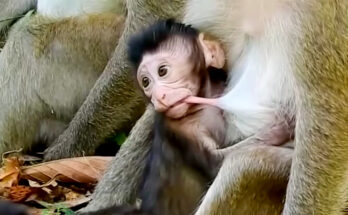
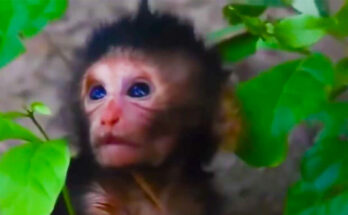
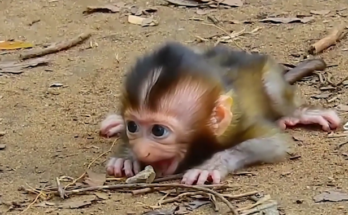
The late morning sun cast golden light through the trees of Angkor Wat’s forest as the troop gathered near the edge of the canopy. Birds chirped overhead, and cicadas buzzed in the distance. Everything felt peaceful—until one sharp cry pierced the stillness.
I was there, just a few feet away with my camera, watching a tiny baby monkey named Lina practicing her balance on a branch. She had just begun to explore without clinging to her mother, her movements wobbly but full of curiosity. It was one of those moments that felt innocent and joyful.
And then it happened.
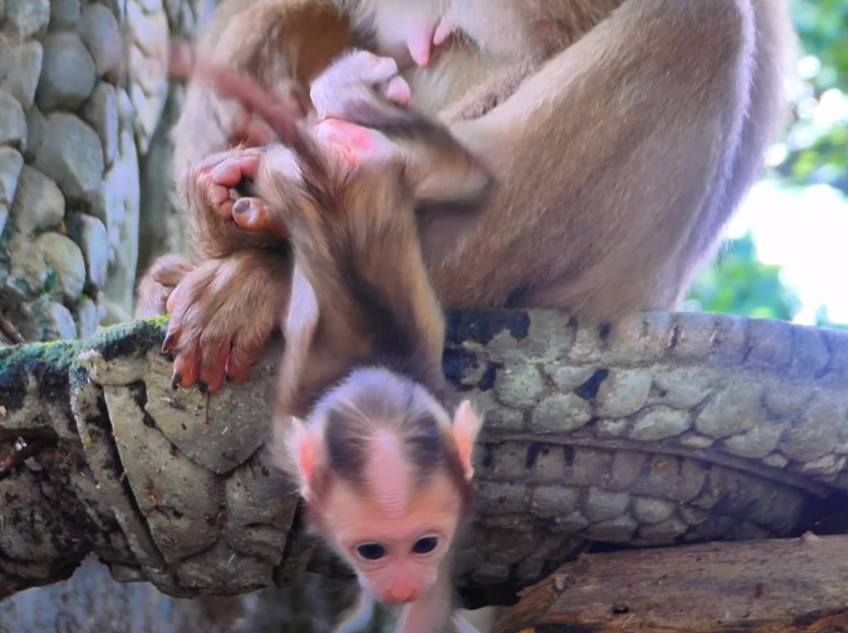
A loud rustle, a sharp slip—and Lina lost her footing. Her small body tumbled from the high branch, flipping helplessly through the air.
My heart dropped.
In that split second, the forest seemed to freeze. Leaves fluttered in her wake. The only thing louder than the thump of her landing was the screech of panic that came from her mother, Mora.
Mora didn’t hesitate. She leapt from a higher branch with a speed and ferocity I didn’t think possible. In one breath, she had covered nearly 20 feet, branches whipping past her face, her whole body a blur of maternal urgency. Her eyes were wide—not with fear, but with fierce determination.
She landed just feet from where Lina had fallen, and within half a second, she scooped her baby into her arms, cradling her tight against her chest.
It was one of the most heartbreaking and beautiful things I’ve ever seen.
Lina whimpered weakly, clearly in shock, her tiny fingers clutching at her mama’s fur. Mora rocked her back and forth, inspecting every limb with trembling hands. The way she gently touched Lina’s head, checking for wounds… it reminded me of a mother checking her child after a bad bicycle fall. The love was the same.
The troop gathered around, forming a protective ring. Even the dominant males who rarely get involved stayed close, clearly understanding the gravity of the moment.
I couldn’t help but think—what if Mora hadn’t been watching? What if she had hesitated, just for a second? That baby might not be here now.
But she had been watching. Always. Even as Lina explored, Mora’s gaze never left her for long. And when her baby was in danger, instinct took over. She didn’t think—she just moved.
It was all over in less than 30 seconds, but it felt like a lifetime.
I watched Mora carry Lina to a quieter spot, hidden in the thicket. She cleaned her daughter’s fur tenderly, her eyes darting around for threats. Lina had a small scratch on her leg, but no serious injuries. Somehow, miraculously, she was okay.
And Mora? She stayed silent. But her body told the story: she was shaking, exhausted, and flooded with adrenaline. Yet even through that, she didn’t stop holding her baby close.
What struck me most wasn’t just the rescue—it was the emotion on Mora’s face after it was done. She looked down at Lina like she had almost lost her whole world.
Because she had.
We often forget, behind the fur and primitive behavior, there are hearts in these mothers just like ours. They worry. They love. They fear. And in moments like this, they show us what real courage looks like.
That day reminded me: love—real love—is instinctive. It doesn’t wait for logic. It doesn’t pause to ask questions. It just moves.
And sometimes, it moves fast enough to save a life.