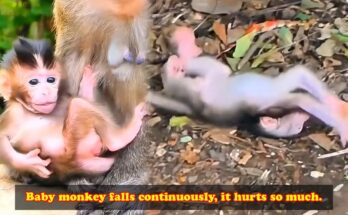
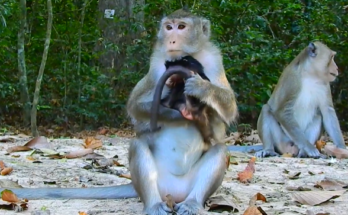
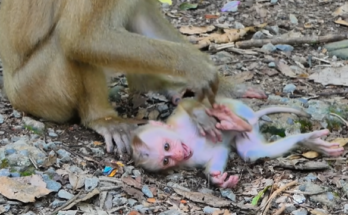
I never expected that my walk through the forest near Angkor Wat would end in a moment that still haunts me — but when I met Pinka and her newborn, I realized how fragile and complicated life in the jungle can be.
It was late afternoon, the sun slanting golden through the trees, casting long shadows over the ancient ruins. I had just set up my camera — the same one I’ve carried for months, to gently capture moments of daily life among the macaque families that live here. I’d heard of Pinka, an older mother monkey whose reputation among the local guides was: steady, experienced, but growing distant.
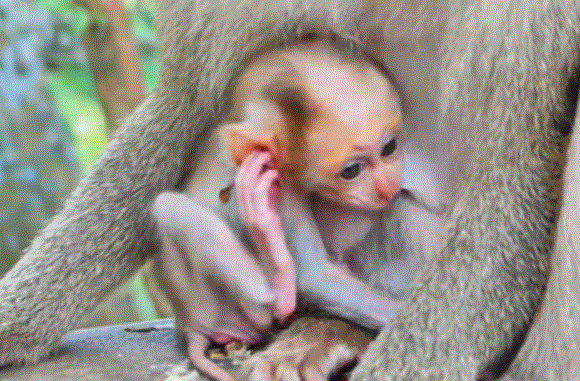
When she appeared, carrying her tiny infant, my heart leapt. The baby was barely older than a week, its fur still soft, eyes still learning how to focus. I felt a wave of tenderness, expecting the kind of protective embrace every mother shows to her young. But instead, I watched her set the baby down on a mossy stone, and then walk away.
At first, I thought she was just stepping away to forage, getting food or checking on something. But as minutes ticked by, it became clear: she wasn’t coming back. The baby sat there, tiny hands clutching at the air, calling out in soft, uncertain chirps. My throat tightened. I could hear its voice echoing so clearly in my recorder, as if the whole forest paused to listen.
Something inside me broke.
I edged closer, making sure not to disturb them. The baby turned, looking for her. Its eyes scanned the trees, its posture was hesitant, desperate. You could almost feel its confusion — Why won’t she come? I wondered if Pinka had learned something I didn’t know: maybe she was too old, maybe she was weary, maybe motherhood had caught up with her in a way that stung more than any physical ache.
I followed Pinka quietly. She sat on a root, cleaning her hands, grooming her fur with concentration, as though she’d forgotten there was a baby somewhere. Once in a while she glanced in the direction where I’d left the infant. But she made no move to return.
Part of me wanted to shout, “Go back, Pinka! She needs you.” But I stayed silent, out of respect for their world.
As the baby cried, a few younger monkeys passed by in the undergrowth. A curious juvenile paused, watching, but didn’t approach. It was as if they sensed something delicate in the air, something broken.
Then, after what felt like forever, Pinka stood and came back — slowly, as if weighed down. My heart jumped. But when she reached the baby, she brushed by, barely touching it. No embrace. No reassurance. Just proximity, and then… she left again.
I felt tears blur my vision. I remembered the first time I saw Pinka: strong, fierce, yet gentle. A guardian of her little clan. Now, she seemed tired, resigned.
In that moment, I realized how motherhood in the wild is not always romantic or heroic. It can be exhausting. It can be lonely. Her rejection of this baby wasn’t bullheaded cruelty — it was weariness, maybe a realization that she might not be able to pour into this little one what she once dreamed of giving. Perhaps she felt the burden of raising another in a forest that doesn’t promise safety.
I sat on a fallen log, camera in hand, as the baby called again. I wanted to scoop her up, comfort her, but I knew I couldn’t. This wasn’t my place. This was nature. And nature has its own rules — sometimes heartbreaking ones.
A few other monkeys slowly gathered nearby, but no one intervened. They respected Pinka’s space, seemed to understand that this was something between mother and child. I prayed, in my quiet human way, that she would change her mind.
As the sun sank lower below the trees, Pinka drifted back once more, coming close to the baby. This time, she lowered her body, as if considering. The baby looked up, hopeful. For a moment, I dared to believe she might pick her up, tuck her close, reignite that bond.
But Pinka sat instead. Just sat. She didn’t pick her up. She didn’t pull her close. She just stayed silent, heavy with something too deep for me to name.
When I finally left that evening, the baby was still there, leaning slightly as she watched Pinka disappear into the shadows. My heart hurt. I knew that this story would stay with me — not just because of what I saw, but because it felt like a mirror for life: love sometimes falters, even when we need it most.
Back home, in the quiet of my room, I replay the video. I see the way Pinka’s expression flickers, like regret or pain. I feel the baby’s vulnerability in every movement and every sound. And I know: there are stories in the forest that are bigger than us, stories of survival, of love, of loss.
I don’t know what will happen to this mother and baby. But I promise to keep watching, kindly, gently, and with respect — so others can see, too, how complicated the life of these monkeys truly is.