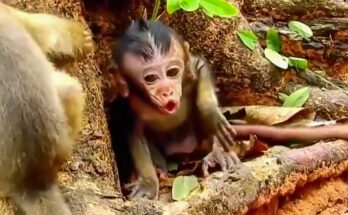
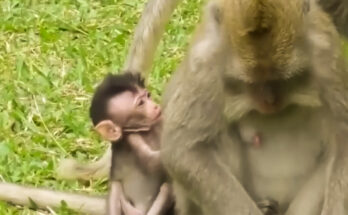
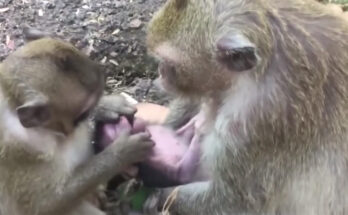
I wandered deeper into the misty forest surrounding Angkor Wat, Cambodia that morning, stepping softly along moss-covered stones and listening to the sound of my own heartbeat echoing in the ancient ruins. The air was thick with humidity, and the forest seemed alive in its quiet: birds called, vines rustled, and somewhere—a little way off—I heard the faint tremble of movement.
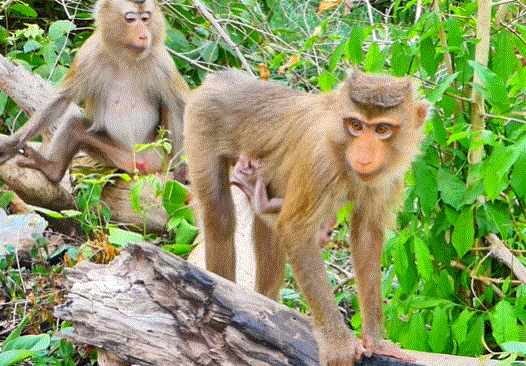
That’s when I saw her: a young mother monkey, her fur slightly matted, her eyes wide with exhaustion and hunger. She was perched between two vast temple stones, the ruins rising like silent watchers above her. My breath caught. The hunger in her eyes spoke volumes: she was carrying a small baby, and she looked so weary it felt like the forest itself held its breath.
She moved slowly, checking the ground and the stone crevices for anything edible—fruit, a fallen leaf, maybe a bug to feed her baby. Every movement seemed weighed down by fatigue. I watched as she paused, stretched a thin arm, then wrapped it protectively around her little one, who clung tightly to her side. The ruin’s shadow fell across her back, and the setting was surreal: an ancient temple, a forest reclaiming stones, and a fragile young mom fighting hunger beneath it all.
I followed her at a safe distance. My heart ached as I saw how often she stopped, pressed a paw to her belly, and seemed to draw in a slow, deep breath as if trying to steady herself. The baby whimpered softly at one point, and the mother’s head snapped around, her eyes scanning the forest, before she bent down and groomed the baby with trembling fingers. The contrast struck me: the ancient, unyielding stones behind them; the delicate struggle of survival here in the shade of history.
Finally, she found a small fruit, half-rotted, lying in a patch of sunlight. Her face lit up with relief for a moment, then worry. The fruit looked small. It might not be enough. But she still picked it up, inspected it, and began to feed her baby first—with the small piece she could reach—then tried to eat a bit herself. Her movements were slow, measured, exhausted. She looked toward me, or at least in my direction, as if wondering: “Will this be enough?”
I turned away for a moment, unable to hold the image. When I looked back, she had eaten more, but the hunger still hovered in her eyes. The baby, now fed a little, nestled close and closed its eyes. The mother shifted, curled around the little one, and exhaled a breath I felt deep in my chest. As I watched, tears blurred the ancient stones. This was not just a wildlife moment—it was a raw, emotional scene of a mother doing everything she had to do.
In that moment, I realized how little we often appreciate the everyday acts of survival—how much strength it takes just to continue, just to feed someone else when you are also starving. The temple, the forest, the monkeys—they all have histories. But right then, it wasn’t about history. It was about now. A young mom so hungry she almost couldn’t stand. A baby safe in her arms. A silent forest bearing witness.
When she finally moved away, disappearing between columns and trees, I felt changed. I felt grateful for my own comforts, and humbled by the stamina of a mother so determined to give her child a chance. The ruins of Angkor Wat are magnificent—timeless even. Yet for all their majesty, it was the fragile young mother in need that taught me the greatest lesson: that love and desperation can coexist in the same gaze, and that survival is never glamorous—but always sacred.