The morning light fell softly through the towering banyan trees of the Angkor Wat forest, painting the mossy ground in gold. The air was thick with humidity, the scent of wet leaves, and distant echoes of chanting monks. I was walking quietly along the stone path when I saw her — Old Jane — sitting alone near a broken temple pillar. Her gray hair clung to her face in the heat, her hands trembling as she stared at the earth.
From afar, Jane looked like any other elder visitor, resting after a long morning walk. But when I got closer, I realized this wasn’t a simple pause — it was a woman in the middle of a storm she couldn’t hide anymore.
She had come to Angkor with her two adult children and two younger men — men her children had brought along, introduced as “friends who help Mom with things she can’t do anymore.” On the surface, it sounded kind. Loving, even. But the truth — as I learned sitting next to Jane that morning — was much darker and much more human.
“They treat me like I can’t think for myself anymore,” she whispered. “And those two young men… they act like caretakers, but it’s not care. It’s control.”
Her voice cracked on the last word. She tried to smile, but it was the kind of smile that hides heartbreak behind politeness.
I watched from the temple steps as her two sons and the younger men stood in the clearing, laughing, taking selfies, unaware — or maybe unwilling to see — the weight crushing the woman who raised them. Jane had once been a teacher, she told me, raising her children alone after her husband passed. She worked hard, sacrificed her dreams, and gave them everything she could.
But now, in her old age, those same children had learned to use her softness as leverage. They introduced her to new “friends” — charming, persuasive, always offering help. Over time, Jane was persuaded to lend money, sign documents she didn’t fully understand, and allow these men to “manage” her daily life.
“I didn’t notice how much I was losing,” she said quietly. “I thought they were just being protective. But one day, they told me I was weak. That I couldn’t make decisions anymore.”
The words broke her.
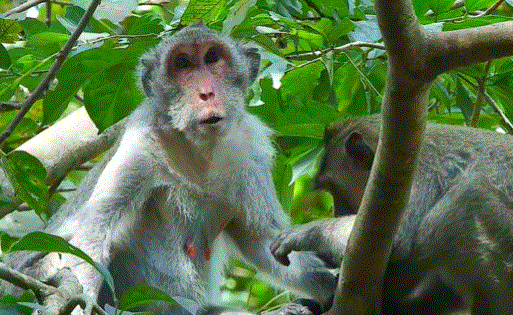
In the silence of that ancient forest, I felt something sacred. The trees seemed to lean closer, listening. The monkeys stopped their chatter and watched from the branches. It was as if Angkor itself was mourning with her.
Then, one of her sons called out impatiently: “Mom! Don’t sit on the ground like that. You’ll hurt yourself.”
She looked up, and for the first time I saw something different in her eyes — anger, not despair.
“Hurt myself?” she said softly. “You already hurt me by treating me like I’m nothing.”
Her voice echoed through the forest. The two young men froze. Her children stared at her, surprised, as if they were hearing their mother for the first time in years. Jane stood, brushing dirt off her knees, and faced them fully — her back straight despite her age, her eyes fierce despite the tears.
“I am old,” she said, “but not broken. I am tired, but not weak. You took my kindness for weakness, and that ends today.”
It was a small moment — but it felt enormous.
The forest wind rustled through the ancient stones, scattering dried leaves at her feet. Even the monkeys seemed to quiet down, as if bearing witness to her awakening.
I stood there, silent, as Jane walked away from the group, toward the temple’s inner path that wound deep into the jungle. Her kids called after her, but she didn’t look back. She just kept walking, her figure slowly disappearing into the misty green.
And somehow, I knew — she wasn’t lost. She was finding herself again.
When she finally reached the edge of the forest clearing, she turned to me and smiled. This time, it was real.
“I used to think my weakness was needing people,” she said. “Now I see — it was believing I didn’t deserve strength.”
I felt tears rise to my own eyes. It wasn’t just about Jane. It was about every person who’s ever been told they’re too old, too tired, too fragile to stand on their own.
That morning, in the sacred silence of Angkor Wat, Jane reclaimed her dignity — and with it, something even greater: the right to decide who she was.