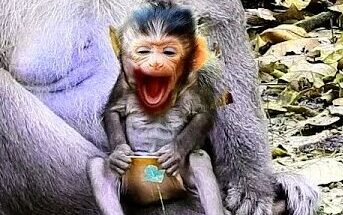
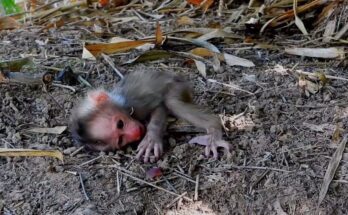
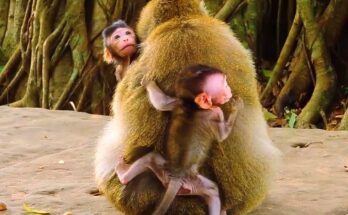
The air in Angkor Wat forest was thick with life that morning. Dew shimmered on the moss-covered stones, and rays of sunlight spilled through the old banyan trees, painting golden patches on the forest floor.
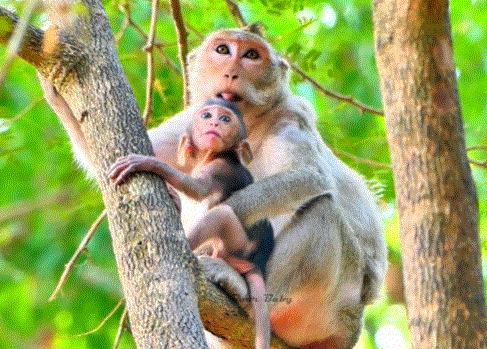
Among the troop of monkeys that called this ancient land home was Baby Poo — a curious, mischievous little soul with bright eyes and a belly full of energy. He was the kind of baby who never sat still for long. Every sound was an invitation, every shadow an adventure.
His mother, Mimi, was calm and wise, with a soft brown coat and eyes that told stories of many seasons. She adored her son — though he often tested her patience with his endless curiosity. That morning, she tried to keep him close as she gathered fruits near the temple wall.
“Stay close, Poo,” she called, glancing back at him. Her voice was gentle but steady — the voice of a mother who had seen too much danger in the forest.
But little Poo was already distracted. His best friends, Tika and Lemo, were chasing butterflies near the edge of the clearing. Their laughter echoed like tiny bells. Without thinking twice, Poo bounded off after them, his tiny tail flicking with excitement.
He tumbled, rolled, and squealed as he joined in the game. The butterflies danced above their heads like drifting petals. The forest around them came alive with the rhythm of their joy.
Meanwhile, Mimi continued her slow climb toward a cluster of trees where food was plenty. She looked back often — at first smiling at her son’s playfulness. But as the minutes passed, her smile faded. The forest was full of beauty, yes, but also full of danger.
She called again, louder this time. “Poo! Come here!”
No answer. Only laughter and the flapping of wings.
She paused, sniffed the air — and her instincts stirred. She had lost sight of him.
Back in the clearing, Poo was too lost in his little world to notice his mother’s call. His tiny hands splashed water from a puddle, and when his friends climbed up the tree, he stayed behind, still giggling.
But slowly, the fun began to fade. His friends grew tired and went their own way. The butterflies disappeared. The laughter quieted.
When Poo finally looked around, the clearing was empty.
“Mama?” he chirped softly.
The word vanished into the thick air.
He climbed a small root, looking left, then right. The forest — so magical a moment ago — now felt enormous. The sound of the wind through the trees turned into whispers.
He climbed higher. The bark scratched his tiny fingers. He called again, louder this time: “Mama!”
Still nothing.
A rustle behind him made him freeze. It was just a leaf falling, but his heart raced. He hugged the tree trunk tightly, his chest rising and falling fast.
Down below, a troop of older monkeys passed by, chattering among themselves. None of them were his mother.
Poo whimpered. His body trembled. His eyes, once full of joy, now brimmed with tears. He had never been alone before.
Far away, Mimi had realized her son wasn’t following. Panic surged through her. She leapt from branch to branch, calling his name with short, sharp cries. Other mothers looked up from their babies, sensing her fear.
She sniffed the ground, followed his tiny scent trail, and listened for even the faintest sound. Her heart thudded louder than the cicadas.
Finally — a whimper.
Her head jerked toward the sound. She bounded through the branches until she saw him: her little boy, crouched on a root, crying softly.
“Poo!” she called.
He looked up instantly. His little face brightened with recognition — and relief — before he burst into tears again.
Mimi ran to him, scooping him into her arms. Poo clung to her tightly, his small hands gripping her fur as if afraid she might vanish again. She pressed her cheek to his, letting out a long sigh that trembled with emotion.
For a long time, they didn’t move. She rocked him gently, making quiet cooing sounds. It didn’t matter that the other monkeys were watching — this moment belonged only to them.
When his crying finally stopped, Poo rested his head on her shoulder. His little heart was still beating fast, but he felt safe again.
Mimi didn’t scold him. She knew he had learned something today — something only experience could teach.
Later that evening, when the sun dipped low and turned the forest amber, Poo followed his mother everywhere. He stayed close when she climbed, waited when she paused, and held onto her tail when she walked.
Sometimes he looked back at the clearing where he had played earlier, as if remembering how quickly joy can turn into loneliness.
That night, as the troop settled down under the giant roots of the strangler fig, Mimi cradled her son in her arms. The sounds of the forest softened — cicadas fading, wind slowing — until it was just the two of them, mother and child, breathing in rhythm.
She watched him drift to sleep, his tiny hand still holding a piece of her fur. She knew he would play again tomorrow — that’s what babies do — but maybe, just maybe, he would look back once in a while to see if she was near.