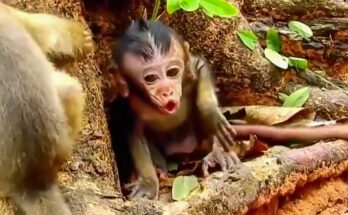
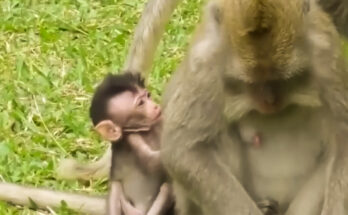
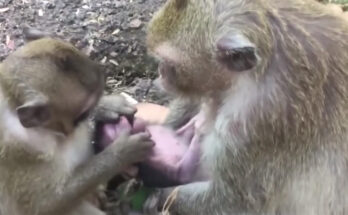
The baby clung to Luna for a few moments, savoring the warmth of her body and the comfort of her familiar presence. Then, almost as if remembering the freedom of the open space, the little one peeked over Luna’s arm and glanced at the forest ahead.
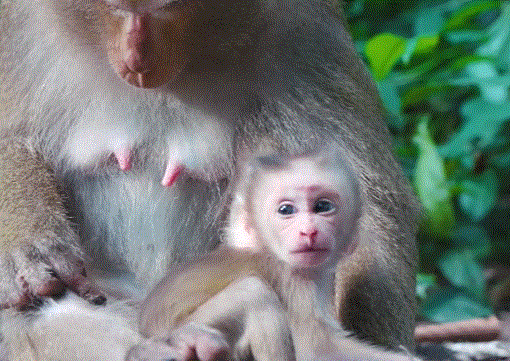
With a gentle nudge, Luna encouraged her baby to step again. Each tiny movement was a triumph—feet wobbling, little arms reaching out for balance, and eyes sparkling with a mix of fear and excitement. Around us, the forest seemed to cheer silently, the wind rustling through the leaves, and distant birds calling as if announcing the baby’s first brave steps.
I couldn’t help but notice Luna’s careful attention. She never rushed her baby; she never scolded or pulled too hard. Her love was patient, full of quiet strength. At one point, the baby fell again, tumbling softly onto the moss. But Luna’s reaction was calm and tender. She placed her hand lightly on the baby’s back, whispering in soft monkey chatter, and the baby tried once more.
It struck me how similar this was to human parenting—the same fears, the same hopes, the same small victories. Every parent has felt the tension of letting a child take their first step, whether onto a soft patch of grass or into the unknown world beyond.
As the morning wore on, Luna guided her baby along a small path lined with roots and ancient stones. Each time the baby took a few steps, Luna made soft encouraging sounds. The little one began to gain confidence, moving with more purpose, discovering the thrill of independent movement.
At one point, the baby stopped, looking puzzled at a tiny puddle glimmering in the sunlight. Luna crouched nearby, tilting her head as if to say, “It’s okay, explore it, you’re safe.” Slowly, the baby reached out and touched the water with a small finger, squeaking with delight as the ripples spread across the surface. That tiny moment—a first curiosity, a first exploration—was more moving than anything I could have imagined.
For the next hour, Luna and her baby wandered through the clearing together. I watched as the baby’s steps grew steadier, almost dancing across the forest floor. Occasionally, other monkeys watched from a distance, curious, but Luna’s focus never wavered. She was teaching, protecting, and giving her baby the courage to discover the world at its own pace.
Finally, the baby climbed a low branch, testing its newfound balance. Luna watched from below, eyes soft, ears twitching with pride. When the baby stumbled, Luna reached out—not to pick it up—but to guide, letting her little one correct itself.
I realized then that what I was witnessing was something universal: the power of patience, the strength of gentle guidance, and the magic of unconditional love. Every stumble, every wobble, every tiny step forward carried a lesson not just for the baby monkey, but for all of us who observe and learn.
As the morning faded into afternoon, the baby finally paused, curled up against Luna, and let out a contented sigh. She had walked, she had explored, and she had learned—yet the journey was only just beginning. Luna pressed her cheek to the baby’s head, murmuring softly, and the forest seemed to hold its breath in that quiet moment of triumph and love.
Even as I walked away, leaving the clearing bathed in golden sunlight, Luna and her baby remained etched in my memory. I thought about how courage is often quiet, how love is often gentle, and how the smallest steps can carry the greatest meaning.
Somewhere in the Angkor forest, under the whispering trees and ancient stones, a baby monkey now walks a little taller, explores a little further, and dreams a little bigger—because a mother named Luna believed, guided, and let her child find its own way.