The ancient stones of Angkor Wat glowed gold in the morning sun. Mist lingered above the forest canopy, and the soft calls of macaques echoed through the air — a haunting harmony that seemed older than time itself.
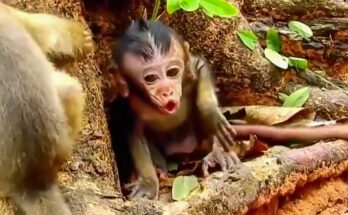
By the temple pond, baby monkey Baila was learning to be brave. Her tiny fingers traced the surface of the water, her reflection rippling and disappearing with every curious touch. She was alone now — or at least, she often felt that way.
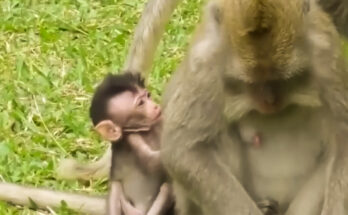
Baila had been abandoned early, left to navigate the harsh world of the troop on her own. But for a while, she had found comfort in Flora, a strong and caring adult female who had taken pity on her. Flora would let her sit close, share her food, and even guide her through the forest trails.
To Baila, Flora was a second mother — maybe even the only one she truly remembered.
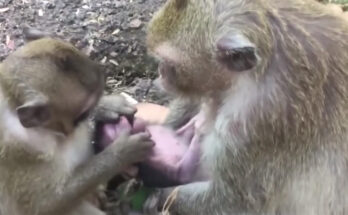
But the forest changes quickly. Seasons shift, babies are born, and loyalties move like shadows. Flora had grown protective of her new group, especially when other monkeys came too close. Baila’s innocent desire to play or share food was often seen as a nuisance by the adults.
That morning, something in Flora’s heart snapped.
Baila splashed too close to her — a soft playful gesture that turned into a moment of misunderstanding. Flora’s ears flicked back; her tail rose in agitation. Her eyes, once soft with care, were filled with fury and confusion.
Then, in a blur of movement — she lunged.
She bit Baila on the shoulder, not to wound deeply, but to send a message: “Stay away.”
The little one screamed, a shrill cry that tore through the still forest. The water rippled with her struggle, droplets flying into the air as she tried to escape.
Nearby, a few tourists gasped. One woman whispered, “Oh no, she’s hurting her!” But the guide shook his head gently. “It’s nature,” he said. “They fight, they love, they learn.”
Still, no one could look away.
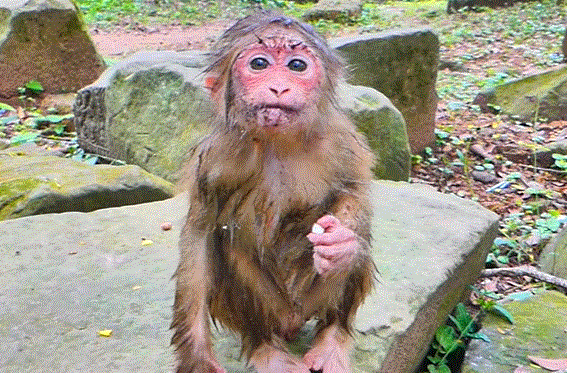
Baila crawled onto a stone, shivering — her fur soaked, her small body trembling. She looked back at Flora, her eyes wide not with anger, but with heartbreak. She didn’t understand. She couldn’t.
Flora stood there, breathing hard. Her anger had passed, replaced by something heavier — guilt. She took a hesitant step forward, as if wanting to make it right, but the group moved, and she followed. She had her place, her duties, her pride.
And so, Baila was left by the water’s edge, watching the only creature she trusted walk away.
The Angkor forest went silent again, except for the sound of dripping water. The ripples faded, but the moment lingered — raw, real, unforgettable.
Later that afternoon, as the sun began to fall behind the temples, Baila was seen again — sitting quietly under a tree, watching the older monkeys eat. She didn’t cry anymore. She just sat, her tiny hands resting on her knees, her gaze calm and deep.
There was something almost human in that look — the way she seemed to understand that love can hurt, that sometimes those who once cared must also let go.
Flora, not far away, glanced back at her once or twice. She didn’t approach, but she didn’t chase her off again either. Maybe in her own way, Flora felt the same ache — a sadness she couldn’t show, but one she carried in her eyes.
That night, the air grew cool and quiet. The Angkor forest shimmered beneath the stars, as if trying to heal what the day had broken.
And somewhere near the temple walls, a small sound rose — a soft, tired whimper that faded into the rhythm of the jungle. Baila had found a warm patch of moss and curled up to sleep.
The day had been cruel, but she survived. Tomorrow, she would rise again — to explore, to play, and to forgive. Because in her little heart, she still believed in kindness, even if it hurt.
And in that fragile belief, she was not unlike us.