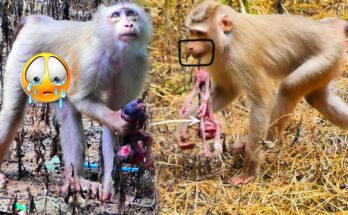
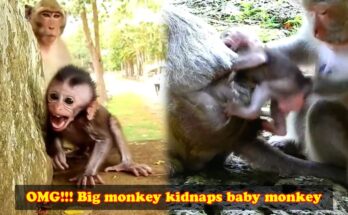
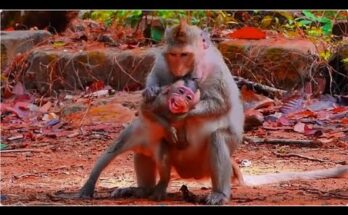
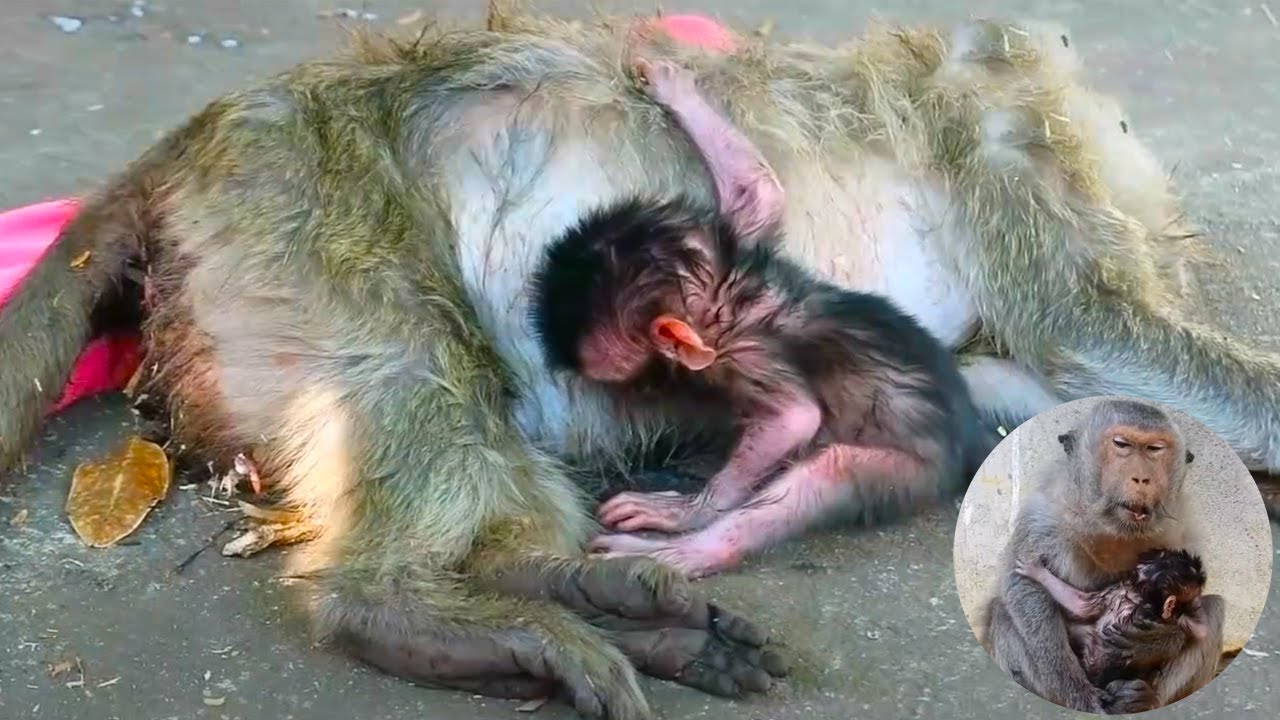
In the quiet canopy of a dense forest, a moment unfolded that stopped wildlife observers in their tracks. A mother monkey, visibly drained after the ordeal of giving birth, lay still while her tiny newborn squirmed beside her, searching instinctively for warmth and nourishment that she could barely offer.
The footage, captured by Wildlife Planet, documents a raw and rarely seen chapter of animal life — the immediate and fragile aftermath of birth in the wild. The mother, her body spent from the physical demands of labor, struggled to hold her infant close. Her movements were slow and labored, a contrast to the restless energy of the newborn pressing against her fur.
For wildlife observers and casual viewers alike, the scene carried an unmistakable emotional weight. The baby monkey, small enough to fit in a human palm, nudged and searched with the blind urgency that defines all newborn life. Around them, the forest continued its indifferent rhythm — branches swaying, birds calling — while this quiet battle for survival played out on a single branch.
Monkey births, much like those of many primates, place enormous physical demands on mothers. The process can leave females exhausted, dehydrated, and temporarily unable to perform the attentive caregiving that infant survival depends upon. In tightly bonded social groups, other females sometimes step in to assist, carrying or grooming newborns while the mother recovers. But in this footage, the mother and her infant appeared largely alone in their vulnerable moment.
What makes the video particularly striking is its honesty. There is no dramatic intervention, no rescue, no tidy resolution — only the unscripted tension of nature doing what it has always done. The mother’s weakness is not a failure; it is a consequence of the immense biological effort she has just completed. Her body, in its exhaustion, is itself proof of what she endured to bring new life into the world.
Slowly, in the later moments of the footage, the mother can be seen making small but deliberate attempts to draw her infant closer. A tentative arm extended. A slight repositioning of her body. These modest gestures, easy to overlook, carry everything — the stubborn, quiet persistence of maternal instinct reasserting itself even through profound physical depletion.
The clip serves as a reminder that wildlife filmmaking, at its best, does not manufacture drama. It simply waits, watches, and allows the natural world to speak for itself. In this case, what it said was both difficult and deeply moving: that birth, in any species, asks everything of a mother, and that the bond formed in those first uncertain hours is among the most powerful forces in the living world.
The footage was published by Wildlife Planet on YouTube and is available at https://www.youtube.com/watch?v=0Yolzn4J6AM.
Watch the original video →