Water is life. For the monkey troops that inhabit forests, riverbanks, and temple grounds across Southeast Asia, proximity to water sources is essential for survival — providing drinking water, food, and cooling relief from tropical heat. But for the youngest members of these troops, that same water can be a silent threat.
A Video That Illustrates the Risk
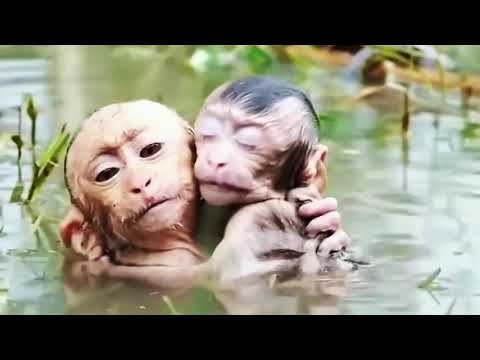
A piece of footage uploaded by YouTube channel Dengta82 brings this reality into sharp focus. The video, titled in Indonesian with a phrase that translates roughly to “So sad, a baby monkey falls and drowns in water,” shows a young monkey losing its balance near a water source and falling in. The small primate struggles visibly, its tiny limbs working against the water as it attempts to stay afloat.
The clip is short and unnarrated, but it tells a story that plays out more often than many people realize. For young monkeys still developing the strength, coordination, and survival instincts that will eventually protect them, a body of water — whether natural or artificial — can be an obstacle they are not yet equipped to handle.
The Biology Behind the Vulnerability
Primates are not born with an instinctive ability to swim. Unlike some mammals that can paddle effectively from birth, most monkey species must develop water navigation skills over time, and these skills come through a combination of physical maturation and observational learning from older troop members.
Juvenile monkeys, typically defined as those between infancy and adolescence, are in a particularly precarious developmental stage. They have often been weaned and are beginning to explore independently, but they lack the muscle mass, limb length, and motor coordination of adults. Their curiosity frequently outpaces their physical capability, leading them into situations — like the one captured in the Dengta82 video — where they are suddenly out of their depth, both literally and figuratively.
Habitats Where the Risk Is Highest
The danger is not uniform across all monkey habitats. In dense forests with gentle streams and shallow puddles, the risk of a young monkey encountering deep water is relatively low. But in environments where monkeys live alongside human infrastructure — temple complexes, urban parks, tourist sites — the water features they encounter may be quite different from what evolution prepared them for.
Artificial ponds, drainage ditches, and ornamental pools often have steep, smooth sides that make it nearly impossible for a small animal to climb out once it has fallen in. Unlike a natural riverbank with roots, mud, and gradual slopes offering handholds, these human-made water features can become traps.
Even in purely natural settings, seasonal flooding, heavy rains, and swollen rivers can transform familiar terrain into dangerous territory overnight. A path that was safe yesterday may be submerged today, and a young monkey following its mother along a known route may suddenly find the ground giving way beneath it.
How Troops Respond
In many primate species, troop members — particularly mothers — are attentive to the distress calls of young animals. When a juvenile monkey falls into water, its vocalizations and splashing can alert nearby adults. In some documented cases, mothers have been observed reaching into water to pull their offspring to safety, and older siblings or other troop members have also been seen assisting.
However, this response is not guaranteed. In large troops where attention is divided, or in situations where the fall happens out of sight, a young monkey may struggle alone for a critical period before help arrives — if it arrives at all. The outcome often depends on factors as simple as how deep the water is, how close the nearest adult is, and how quickly the young animal tires.
What the Footage Reminds Us
The video from Dengta82 is a window into one of the quieter dangers of primate life — not the dramatic threat of a predator, but the everyday hazard of living near water without the full ability to navigate it safely. It is a reminder that the natural world, for all its beauty, operates on terms that are unforgiving to the young and vulnerable.
For those who manage habitats where monkeys and humans coexist, the footage is also a prompt to consider whether simple modifications — ramps in artificial ponds, shallower edges on water features, barriers near deep channels — could reduce these risks without disrupting the animals’ access to the water they need.
The baby monkey in this video faced a danger that countless young primates encounter in silence every day. This time, a camera was there to record it — and in doing so, to remind us that the smallest members of any community are often the most at risk.
Source: Video by Dengta82 on YouTube — https://www.youtube.com/watch?v=Z6IaT4OhS3g
Watch the original video →