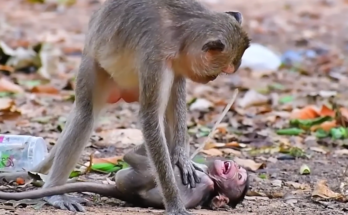
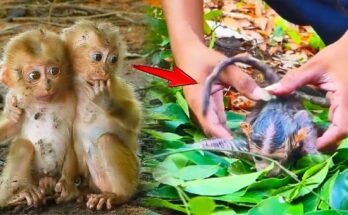
In a scene that is both deeply uncomfortable and painfully natural, a small baby monkey named Leo clings to his mother, his tiny face contorted in distress, his cries echoing through the surrounding trees. The footage, captured and shared by the YouTube channel Monkey Library, documents a moment of visible tension between a primate mother and her vulnerable infant — one that has drawn attention from viewers around the world.
What the Video Shows
The video opens on baby Leo, a young macaque whose wide eyes and trembling limbs immediately signal that something is wrong. He cries out repeatedly, his shrill vocalizations cutting through the ambient sounds of the natural environment. His mother, rather than offering comfort in a way human observers might expect, appears to handle him in a manner that causes him further distress.
Throughout the footage, Leo can be seen attempting to cling to his mother, only to be moved or repositioned in ways that elicit louder cries. At various points, the baby appears to reach out, seemingly seeking reassurance or a gentler hold. The mother’s behavior, while not necessarily unusual in the context of wild primate social dynamics, is visibly rough from a human perspective.
A Distressed Infant’s Struggle
What makes the footage so compelling — and so difficult to watch — is the raw emotion on display. Baby Leo’s facial expressions shift between confusion, fear, and what appears to be outright pleading. His cries grow louder at certain moments, particularly when his mother adjusts her grip or moves abruptly. The small monkey’s vulnerability is on full display, and there is no mistaking the distress in his vocalizations.
The camera captures these interactions without interference, maintaining a documentary distance that allows the natural behavior to unfold. There are no human hands reaching in to intervene, no narration offering immediate judgment. The footage simply presents what is happening, leaving viewers to process the scene on their own terms.
Primate Parenting in the Wild
For those unfamiliar with macaque behavior, it is worth noting that primate mothering styles vary widely, even within the same species. Primatologists have long documented that some macaque mothers are more nurturing while others adopt harsher approaches to handling their young. Factors such as the mother’s age, social rank, stress levels, and prior experience with infants can all influence how she interacts with her baby.
This does not make the footage any easier to watch. For many viewers, the instinct to protect a crying infant — regardless of species — is deeply ingrained. The sight of baby Leo’s distressed face triggers an empathetic response that transcends the boundary between human and animal.
The Broader Observation
Channels like Monkey Library serve as windows into the daily lives of wild and semi-wild primate populations. The footage they capture, while sometimes difficult, provides valuable observational data about how these animals interact, parent, and navigate their social hierarchies. Baby Leo’s cries, as painful as they are to hear, are part of a larger story about survival, attachment, and the complex dynamics of primate family life.
As the video draws to a close, Leo remains with his mother, his cries gradually subsiding but his discomfort still evident. Whether this moment represents a temporary episode of rough handling or a pattern of behavior remains unclear from a single video. What is clear is that baby Leo’s distress was real, visible, and deeply affecting to those who witnessed it.
Source: “S-ad Facial Of Baby LEO Was C-rying L0udly For Mom St0p !!Mom’s Behavior Is Making Baby LEO H-ardly” — Monkey Library, YouTube (https://www.youtube.com/watch?v=o7hl7aOefKs)
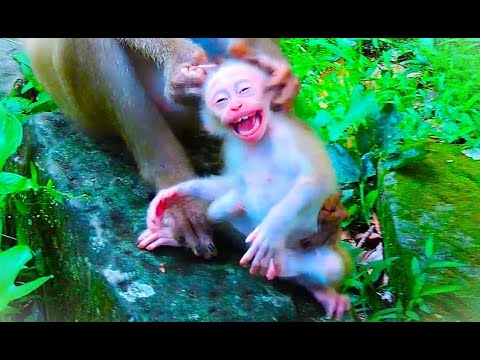
Watch the original video →