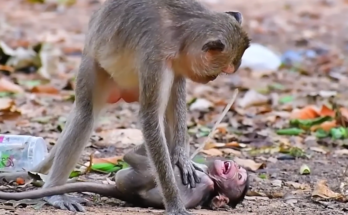
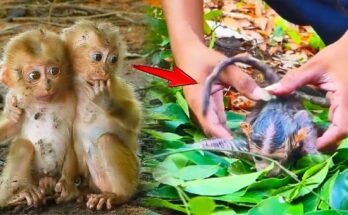
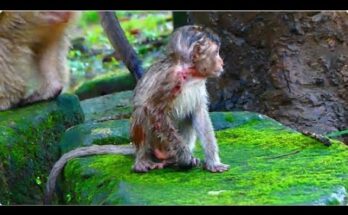
It is one of those moments that can make a human observer wince. A tiny baby monkey, barely old enough to navigate the world on its own, reaches for its mother’s milk — and is firmly pushed away. Then it tries again. And again. Each time, the answer is the same: no.
A recent video posted by the YouTube channel Top Macaques captures this exact scenario in vivid detail. A baby macaque makes multiple attempts to nurse from its mother, and each attempt is met with physical redirection. The mother blocks her infant, moves away, and refuses to allow nursing to continue.
To the casual viewer, it might look callous. But to those who study primate behavior, it is a scene loaded with significance — one that reveals something important about how young monkeys learn to survive.
The Role of Weaning in Primate Development
What the video documents is most likely the weaning process, a critical phase in the life of every young primate. Weaning is the gradual transition from a diet of mother’s milk to solid food. It does not happen overnight, and it is rarely smooth. In macaque communities, it often involves exactly the kind of repeated refusal and infant protest seen in this footage.
For the baby, the transition is difficult. Milk is familiar, comforting, and nutritionally complete. Giving it up means learning to find and eat solid foods, which requires new motor skills, new foraging behaviors, and a level of independence the infant has never before needed.
For the mother, weaning serves multiple purposes. It conserves her energy and physical resources, allowing her body to recover from the demands of lactation. In many primate species, weaning also coincides with the mother’s return to reproductive readiness, meaning it plays a role in the broader survival strategy of the group.
Why Observers Should Not Mistake Firmness for Cruelty
One of the most important takeaways from footage like this is the distinction between what looks distressing and what is genuinely harmful. The mother in this video is not injuring her baby. She is not abandoning it. She remains physically close, allows the infant to stay by her side, and simply denies access to nursing.
This kind of firm boundary-setting is a well-documented part of macaque mothering. Primatologists have observed that mothers who wean their infants — even when the process involves protest from the baby — are not providing lower-quality care. They are, in fact, promoting the kind of independence that the infant will need to thrive as a juvenile and eventually as an adult.
What This Means for Understanding Primate Welfare
Videos like this one matter because they shape public perception of animal behavior. When footage of a mother denying milk to her baby circulates online, it can easily be misinterpreted as evidence of poor mothering or suffering. Understanding the biological context behind the behavior helps audiences make more informed judgments about what they are actually seeing.
Macaques, like many primates, live in complex social structures where developmental milestones are influenced by a range of factors — the mother’s health, the availability of food, the presence of other group members, and the age and size of the infant. Weaning is not a single event but a process that unfolds over weeks or even months, with exactly the kind of back-and-forth negotiation captured in this video.
A Lesson in Patience and Persistence
Perhaps what makes this footage so compelling is the baby’s refusal to accept the situation quietly. It returns to its mother after every rejection, undaunted. This persistence is itself a survival trait — an infant that gives up too easily risks being overlooked or under-nourished. The mother’s firmness and the baby’s determination are two sides of the same evolutionary coin.
By the end of the video, the pair remain together. The milk was denied, but the relationship was not. And somewhere in that tension between a mother’s resolve and a baby’s need lies one of nature’s most fundamental lessons: growing up is hard, but it is also necessary.
Source: “The baby monkey asked for milk many times but was ruthlessly stopped by the mother monkey” — Top Macaques, YouTube (watch here)
Watch the original video →