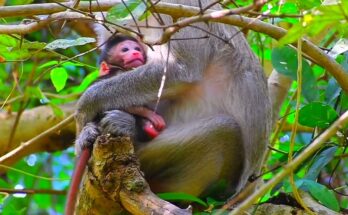
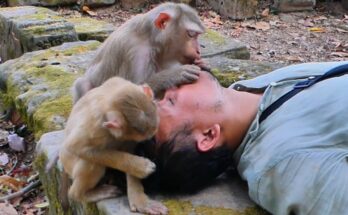
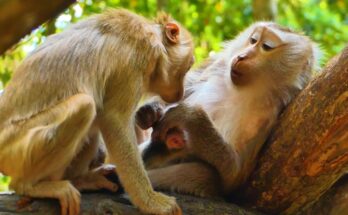
The forest was still waking when it happened. Morning light filtered gently through the ancient Angkor trees, touching mossy stones and low branches where the monkeys often rested. The newborn clung closely, unsteady and curious, pressing into his mother’s side as if the world were already too large.
She shifted. Not abruptly. Not with anger. Just enough.
The baby slipped from her arms and landed softly on the forest floor.
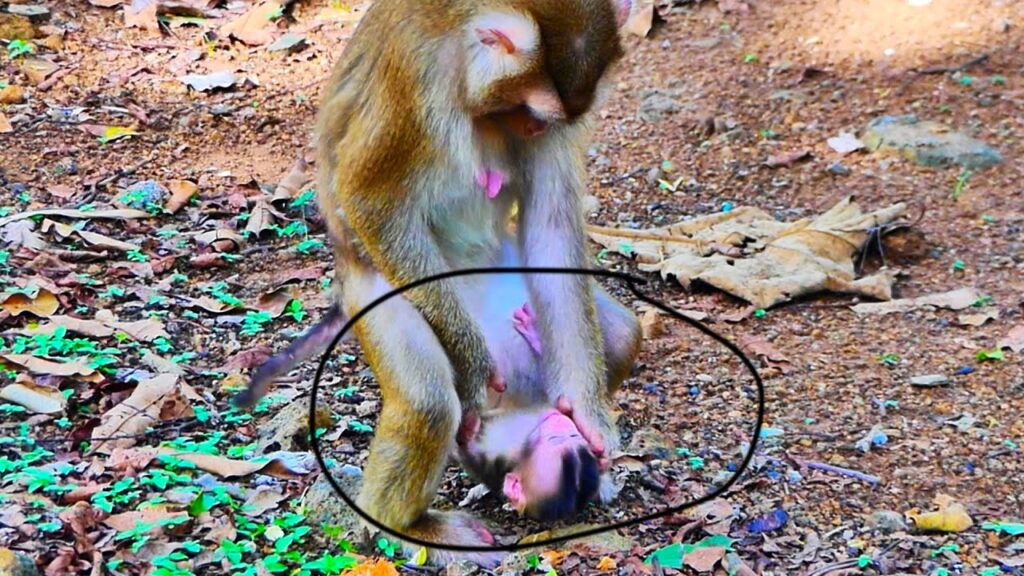
For a moment, he froze—small hands splayed against the earth, eyes wide with confusion. Then came the sound every observer recognizes instantly: a thin, uncertain cry, not loud, but searching.
The mother did not rush. She stayed where she was, watching. Her posture was calm, grounded. This was not abandonment. It was instruction.
In the wild, closeness must be earned gradually. Even love requires boundaries.
The baby tried to stand. His legs wobbled, buckled, then steadied again. He looked up toward his mother, calling softly, as if asking whether he had done something wrong. She remained still, eyes attentive, allowing the moment to stretch just long enough for learning to begin.
Around them, the forest continued its rhythm—birds calling, leaves shifting, distant movement among the trees. Life did not pause, even for a newborn’s first disappointment.
Eventually, the mother stepped down, guiding him back with a gentle pull. Not a reward, not a rescue—just reassurance. The lesson was complete.
This was not cruelty. It was preparation.
In the Angkor forest, every young life must learn balance early. Strength grows not only from protection, but from small moments of separation that teach confidence. What looked like sadness was, in truth, the beginning of independence.
To witness it was to understand something deeply human: love does not always hold. Sometimes, it lets go—just enough.