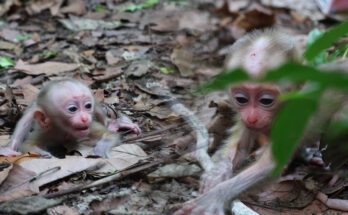
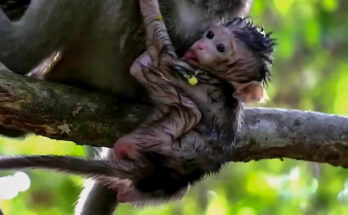
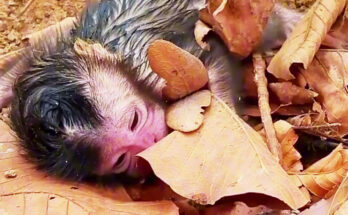
Early one morning in the Angkor Wat forest, the soft sounds of birds echoed through the ancient trees as a young female monkey experienced one of the most important moments of her life. She had become a mother for the very first time.
The tiny newborn rested against her chest, still adjusting to the world outside the safety of the womb. Everything was new—not only for the baby, but also for the young mother.
From a nearby viewing area, it was impossible not to notice her uncertainty. She carefully looked down at her infant and shifted her position several times. Unlike experienced mothers who confidently carry their babies while climbing and foraging, this young female seemed unsure about how to hold her newborn comfortably.
For several minutes, she sat quietly beneath a large tree. The baby attempted to cling to her fur, but the mother occasionally adjusted her grip, appearing to search for the safest position. There was no panic. Instead, it felt like watching someone learn an important skill through patience and instinct.
The surrounding troop carried on with their daily activities. Older females moved through the forest canopy while juveniles played among the roots and branches. Yet the young mother remained focused entirely on her baby.
One particularly touching moment occurred when the newborn shifted slightly and began reaching upward. The mother immediately lowered her head and gently inspected the infant. It was a simple interaction, but it revealed the growing bond between them.
As the morning continued, something remarkable happened. The mother slowly became more confident. Each adjustment seemed more natural than the last. She began holding the baby closer against her body, creating a secure position that allowed the newborn to rest peacefully.
Watching this process felt surprisingly familiar. Across many species, including humans, first-time parents often learn through experience. Books and instincts can help, but real confidence grows through caring for a child day by day.
The young monkey seemed to be discovering this lesson in real time.
Nearby, an older female briefly approached and observed the pair. Whether offering reassurance or simply checking on them, her presence highlighted the strong social structure often found within monkey communities. New mothers are rarely completely alone.
The newborn appeared increasingly relaxed as the hours passed. Protected by its mother’s arms and warm fur, the tiny infant occasionally peeked out at the surrounding forest before settling back into a comfortable position.
The Angkor forest provided a beautiful backdrop for this special moment. Sunlight filtered through the leaves, creating shifting patterns across the ground. Ancient stones stood quietly in the distance, reminders of centuries of history unfolding alongside everyday wildlife stories.
By midday, the difference in the young mother’s behavior was noticeable. The uncertainty seen earlier had begun to fade. She moved more confidently, carrying her baby with greater ease while remaining attentive to every small movement.
The experience offered a gentle reminder that parenting is often a journey of learning. Nobody begins as an expert. Whether human or monkey, new mothers and fathers grow into their roles through patience, observation, and love.
As the family disappeared deeper into the forest, one thing was clear: a strong bond was already forming between mother and child. The young female may have started the day unsure of herself, but she ended it with growing confidence and a deeper connection to the tiny life depending on her.
It was a quiet moment, yet one that perfectly captured the beauty of new beginnings in the Angkor Wat forest.
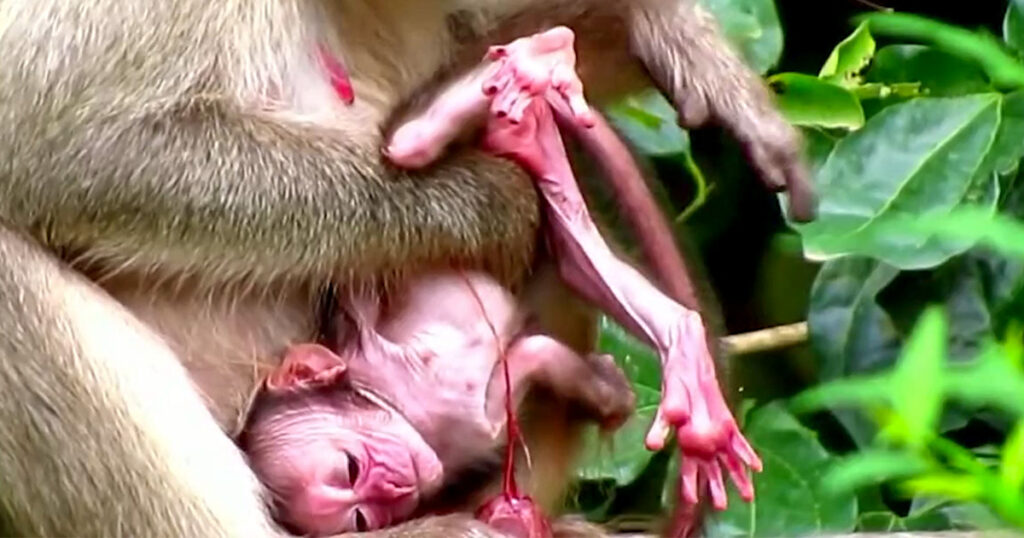
A young monkey became a mother for the first time in the Angkor Wat forest. Unsure how to hold her newborn at first, she gradually gained confidence throughout the day. Watching the pair interact revealed a touching story of learning, patience, and the beginning of a strong mother-child bond.