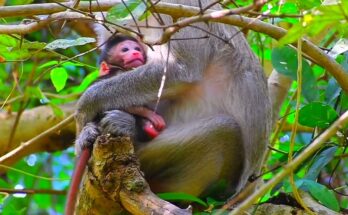
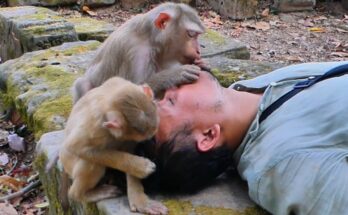
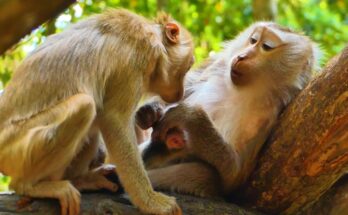
I was standing still beneath the tall trees of the Angkor Wat forest when it happened—one of those moments so small you almost miss it if you blink.
The young mother monkey moved carefully across the forest floor, her baby pressed close against her chest. The baby was tiny, still learning how the world worked beyond warmth and fur. Every step the mother took seemed deliberate, thoughtful, as if she were listening not only to the forest, but to her child.
Then, without drama or urgency, she lowered the baby onto the ground.
The baby froze.
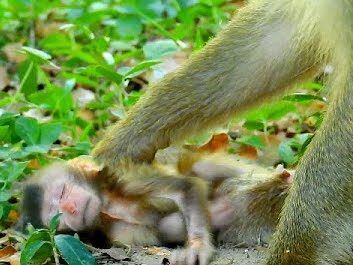
There was no cry, no sudden movement—just a pause. The baby’s small hands touched the earth as if asking a question it didn’t yet know how to ask. The forest felt unusually quiet in that second, like everything around us was waiting.
Why here? Why now?
The mother didn’t leave. She stayed close, watching, standing just a step away. Her eyes followed every movement as the baby shifted uncertainly, adjusting to the feeling of standing alone. It wasn’t abandonment. It was something else—something patient, something intentional.
The baby took a breath and looked up, searching for her face.
That look said everything.
It reminded me of how learning begins—not with confidence, but with trust. The mother wasn’t pushing her baby away. She was giving space. Space to feel the ground. Space to balance. Space to begin.
A moment later, the mother reached down and lifted the baby back into her arms. The baby clung tighter this time, as if holding onto a new understanding: the ground isn’t the end. It’s part of the lesson.
In the Angkor forest, life doesn’t announce itself loudly. It teaches quietly, through moments like this—where love and learning happen side by side.
I didn’t feel like I was watching wildlife. I felt like I was witnessing something deeply familiar. Something human.