The morning light moved slowly through the Angkor Wat forest, soft and golden, settling on stone paths and low branches where a troop had gathered. Two baby monkeys clung close to their mothers, still learning how the world worked beyond fur and warmth.
They were curious, but cautious. One reached out toward a fallen leaf. The other watched, wide-eyed, mirroring every movement. Their mothers stayed close, bodies angled just enough to shield without restricting. This is how protection looks in the wild—subtle, constant, patient.
Then something shifted.
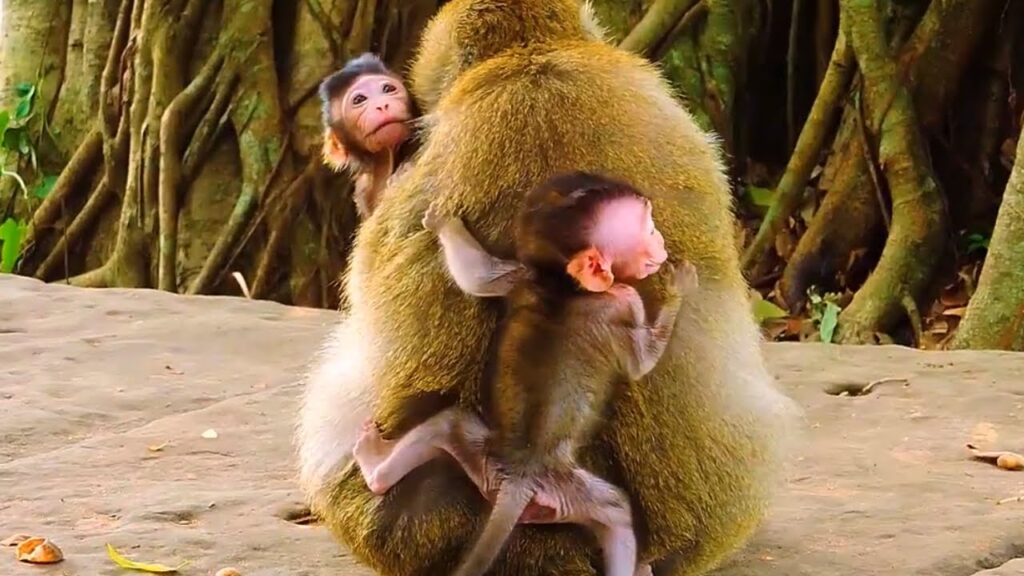
A person nearby moved too quickly, unaware of how fragile the moment was. It wasn’t intentional harm—just noise, closeness, unfamiliar energy. The babies stiffened. One pressed into its mother’s chest. The other froze, unsure whether to climb or stay still.
What happened next wasn’t dramatic. It was careful.
A calm human voice lowered. A step back. A pause that allowed space to return. The mothers adjusted their positions, forming a quiet barrier. No sounds of alarm, no chaos—just instinct meeting awareness.
In that stillness, the babies relaxed.
One tucked its face beneath its mother’s arm. The other settled, fingers curling into familiar fur. The forest resumed its rhythm—birds calling, leaves shifting, ancient stones holding the silence of centuries.
Moments like this rarely make noise. They don’t demand attention. But they matter.
Protecting wildlife isn’t always about rescue. Sometimes it’s about restraint. About recognizing when to stop moving forward and let life continue as it should. In Angkor Wat, where humans and monkeys share sacred ground, these small choices shape trust.
As the troop moved deeper into the trees, the babies remained close, safe in the circle of their mothers and the restored calm of the forest. The moment passed, but the lesson stayed.
Protection doesn’t always look heroic.
Sometimes, it looks like stepping back.