I will never forget the sound.
It wasn’t loud. It wasn’t dramatic.
It was soft, shaky, and desperate—the cry of a baby monkey who didn’t understand why his mother wasn’t responding.
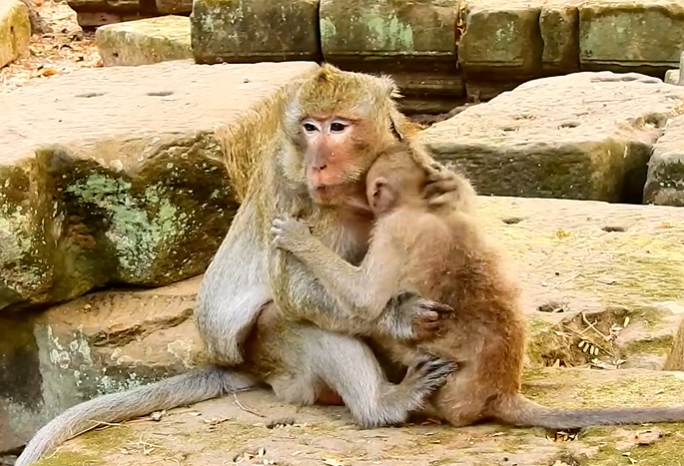
That morning in the Angkor Wat forest, the ancient stones were quiet. Sunlight filtered gently through the towering trees, casting warm shadows over roots that have witnessed centuries of life, loss, and survival. Birds called from afar. Tourists hadn’t arrived yet. Everything felt still—until Jayden cried.
Jayden is small, even for a baby monkey. His fur is lighter than most, and his eyes are wide, curious, and painfully expressive. He clung to a low branch near his mother, Jade, his tiny hands gripping tightly as his body trembled with hunger.
He made the sound again.
A thin, pleading cry.
Jayden wasn’t playing. He wasn’t calling out of fear.
He was asking for milk.
I watched as he slowly reached toward Jade, stretching one fragile arm, his body leaning forward with hope. His mouth opened slightly, the way all babies—human or animal—do when they expect comfort.
But Jade didn’t turn.
She sat upright, alert, scanning the forest, focused on something only she could sense. Danger. Competition. Survival. Her eyes were sharp, her posture tense. In the wild, a mother’s attention is constantly divided, and sometimes, heartbreakingly, a baby’s needs must wait.
Jayden cried again—louder this time.
His small chest rose and fell quickly. He shifted his feet, nearly losing balance before catching himself. The sound he made wasn’t just hunger. It was confusion. It was the fear of being unseen.
I felt my throat tighten.
As humans, we instinctively respond to a baby’s cry. We want to step in, to comfort, to fix what hurts. But in that moment, all I could do was watch—because this was their world, and interference can change everything.
Jayden moved closer, almost crawling beneath Jade. He nudged her gently with his head, searching for warmth, for reassurance. Still, she ignored him—not cruelly, but firmly. This was not the moment she could provide what he wanted.
Minutes passed.
Each second felt heavy.
Jayden finally sat back, his shoulders slumped, his cries growing weaker. He looked down at the ground, then back up at his mother, as if asking a question he didn’t know how to form: Why not now?
That look stayed with me.
People often see monkeys as playful, funny, or mischievous. But moments like this reveal something deeper—something painfully familiar. Hunger. Need. Dependence. The fragile bond between a mother and her child, tested by the harsh rules of nature.
Eventually, Jade shifted. She glanced down, just once. Jayden froze, hope flashing across his face. But the moment passed. She moved away, and Jayden was left sitting alone on the branch, silent now, conserving what little energy he had.
The forest returned to its quiet rhythm, but my heart didn’t.
Jayden’s cries may have faded into the trees, but their echo lingered. They reminded me that in the wild, even love must bend to survival—and that sometimes, the most heartbreaking moments are the quiet ones no one else notices.
If you listen closely, you can still hear him.