I still remember the sound.
It wasn’t loud — just a sharp crack, like a dry branch snapping under pressure. But in the stillness of the Angkor Wat forest, that sound echoed straight into my chest.
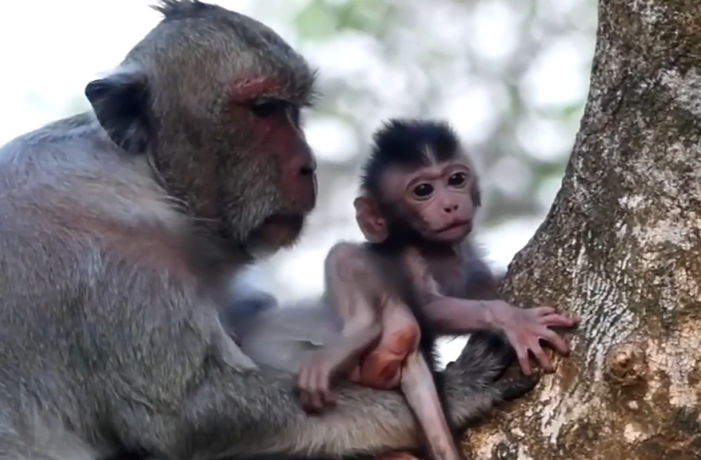
I had been standing beneath the trees for nearly an hour, quietly watching a small troop of monkeys move through the canopy above me. Morning light filtered down through ancient branches, painting the forest floor in gold and shadow. Everything felt peaceful. Predictable.
Until it wasn’t.
High above, a young monkey — small, curious, full of fearless energy — climbed farther than the others. He tested each branch with quick movements, swinging and pausing, clearly proud of how high he’d gone. I smiled to myself, thinking how children — human or not — always push boundaries.
Then his grip slipped.
For a split second, his eyes widened. I saw it clearly. And then gravity took over.
He fell.
Not slowly. Not gently. He dropped straight down from the sky, tumbling through leaves and air, his tiny body spinning helplessly. I gasped so loudly it startled even me. My heart slammed against my ribs as I watched him fall — knowing I was powerless to stop it.
When he hit the ground, the forest went silent.
No birds. No chatter. Just the sound of my own breath caught in my throat.
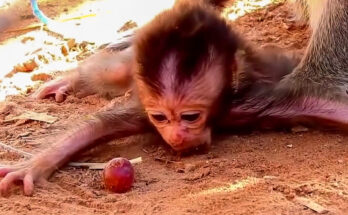
He lay there — motionless.
I felt a strange ache spread through my chest, the kind that comes when your mind hasn’t yet accepted what your eyes are seeing. I took a step forward, then stopped. I didn’t know what to do. I didn’t know if I should move closer or stay still.
Seconds felt like minutes.
Then… his fingers twitched.
I nearly cried with relief.
Slowly, painfully, he lifted his head. His breathing was shallow. His body trembled. He looked around, confused, scared — as if trying to understand how the world had suddenly betrayed him.
From the trees, the troop reacted instantly.
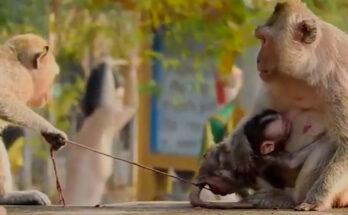
Sharp cries echoed above as adult monkeys rushed toward the clearing. A mother — maybe his own, maybe not — climbed down first. She didn’t touch him right away. She watched. Carefully. Protectively. Like she was making sure he was still here.
I stayed frozen, afraid that any movement might make things worse.
The young monkey tried to stand. He failed. Fell back down. Tried again. This time, he managed to sit upright. His face looked stunned — not just from pain, but from fear. From realizing how close he’d come to something irreversible.
That look… I’ll never forget it.
We often see wildlife as strong, agile, untouchable. But in that moment, he looked so small. So fragile. Just a child who had trusted a branch that gave way.
After a while, he stood again — wobbling, limping, but standing. The troop gathered close, forming a loose circle around him. No panic. No aggression. Just presence.
Family.
Eventually, with a soft call from one of the adults, he moved toward the trees. Slowly. Carefully. Every step mattered now. He climbed low this time, staying close to the trunk, learning — instantly — from what had just happened.
Before disappearing into the leaves, he turned his head and looked back.
I don’t know why, but I felt like he was looking at me.
Maybe it was coincidence. Maybe it was nothing. But it felt like acknowledgment — of shared fear, shared relief, shared survival.
When he was gone, the forest noise returned. Birds resumed singing. Leaves rustled again. Life went on.
But I didn’t.
I stood there long after, shaken, reminded that nature isn’t just beautiful — it’s unforgiving. That survival isn’t guaranteed. And that even in the wild, there are moments that mirror our own lives perfectly.
We climb. We slip. We fall.
And sometimes, if we’re lucky, we get back up.
That day at Angkor Wat forest didn’t just give me a video.
It gave me a memory — one that still tightens my chest every time I hear a branch crack above my head.