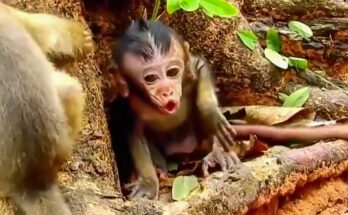
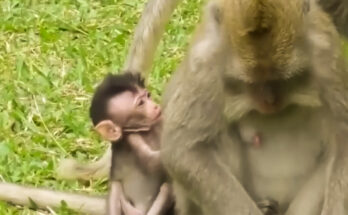
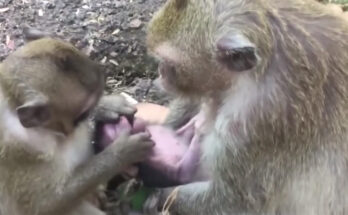
The Angkor Wat forest is often full of life—sounds of rustling leaves, playful young monkeys leaping from branch to branch, and the hum of ancient winds passing through thousand-year-old stones. But on this particular morning, the forest felt unusually quiet. Even the cicadas, always so loud at sunrise, seemed to soften their song.
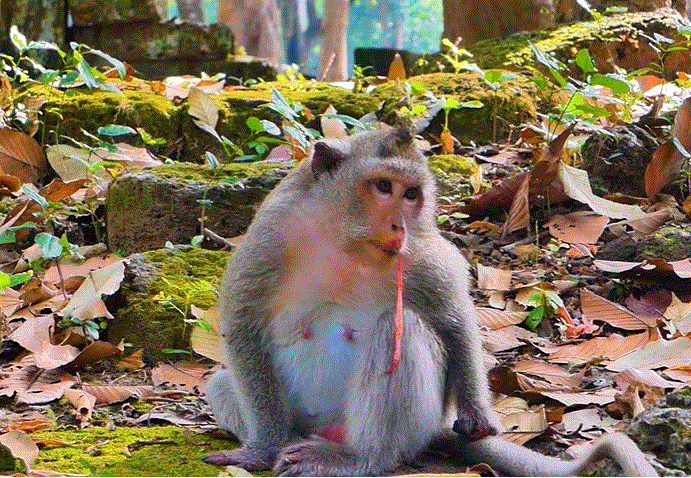
I had been walking along one of the narrow forest paths when I saw her—a young mother monkey sitting at the foot of a tree, her arms wrapped tightly around something small. At first, I couldn’t tell what she was holding, but her trembling body and soft cry told me something was terribly wrong.
As I stepped closer, the truth hit me like a punch to the chest.
She was holding her newborn… but the tiny body wasn’t moving. No small breath. No tiny fingers gripping the air. No soft squeak. Just stillness.
The mother monkey—whom local observers often call Soma—was doing everything she could to revive her baby. She gently nudged the limp little body, then pulled it close to her chest as if trying to warm it back to life. Her eyes told the story most clearly: a storm of confusion, hope, fear, and a heartbreak that words could never fully capture.
She kept hugging her newborn, pressing her cheek against his head, almost as if she believed her love alone could restart his heartbeat.
The forest watched in silence.
A few other monkeys from her troop approached hesitantly. They weren’t aggressive—just curious, confused, unsure. One older female reached out to touch the baby, but Soma pulled her newborn closer, shielding him the way any mother would.
That moment shattered me.
It reminded me of the universality of motherhood—the instinct to protect, the refusal to accept loss, the desperate attempt to hold onto the little life you carried. It didn’t matter that this was the wild, or that these were monkeys. The emotion was unmistakably human.
Soma eventually curled her body around her baby, rocking gently. Every few seconds, she lifted his tiny arm, as if hoping it might move on its own. She nudged the baby’s cheek, then touched his nose, trying again and again to find some sign that he was still there.
But nature had already made its decision.
Hours passed. The sunlight changed, turning from the soft gold of morning to the bright warmth of midday. Troop members wandered off to forage, but Soma stayed right where she was, refusing to leave the last place she held her baby alive.
I realized then that grief is not unique to humans. It lives in the hearts of all mothers who love their children fiercely.
Eventually, as the shadows began to shift across the mossy ground, Soma seemed to understand. She lifted her baby one last time, pressing her forehead to his. The moment was so quiet, so fragile, that even the wind paused.
She placed him gently on the forest floor.
Then she sat beside him, not ready to walk away, but slowly accepting the truth she had fought so hard against.
The image of that trembling mother, sitting beside the tiny stillborn newborn she loved with every beat of her heart, will stay with me forever. It taught me how deeply animals feel, how fiercely mothers love, and how universal grief truly is.
In that silent forest, surrounded by ancient temples and whispering trees, I witnessed a mother’s love that transcended species. And I hope anyone who sees this story will feel the tenderness, the sorrow, and the quiet beauty of the moment—because it deserves to be remembered.